20 Second Timeout is the place to find the best analysis and commentary about the NBA.
Saturday, September 07, 2019
The Basketball Hall of Fame Welcomes A Diverse Class of 12 Inductees
The 2019 Naismith Memorial Basketball Hall of Fame class includes the first black player drafted by an NBA team (Chuck Cooper of the Boston Celtics), an all-black team that became the first squad to win three straight collegiate national championships (Tennessee A&I, 1957-59), the New York Knicks' first superstar (Carl Braun), the pioneering women's team from Wayland Baptist, two of the greatest defensive players in pro basketball history (Bobby Jones and Sidney Moncrief), the face of the Warriors' franchise for six decades (Al Attles), two prominent NBA All-Stars from the 1970s/1980s (Paul Westphal and Jack Sikma), NBA championship-winning coach Bill Fitch, one of the first European players to make a big impact in the NBA (Vlade Divac) and one of the WNBA's first stars (Teresa Weatherspoon).
Divac gave the first speech during Friday night's induction ceremony. I was struck by the fact that when he first arrived in the United States he did not speak a word of English, but now he gave a wonderful Hall of Fame acceptance speech in that language. Think about that for a moment. Could you move to Serbia in your 20s, qualify for the Hall of Fame in some endeavor and then give your acceptance speech in Serbian? Divac declared, "To me, the game of basketball has always been about love." He also said, "You have to give in order to receive...Basketball is the opposite of selfishness. Basketball is solely about giving and sharing and caring for one another."
Jack Sikma is
one of the few players who has a move named after him. Sikma patented
the inside pivot move that is now referred to by his name. He had
tremendous footwork and smarts. Before the ceremony, Bill Walton said,
"He was a beautiful player" and a "brilliant analyst as to what to do
(and) when (to do it)." In the final three seasons of his career,
Sikma--who up to that point had made seven three point field goals in
the nine years since the league had added the three point arc to the
court--shot 203-618 (.328) on three pointers. His coach, Milwaukee's Del
Harris, was two decades ahead of his time in terms of spacing the court
and having his center shoot from long distance--and Sikma was both talented enough and smart enough to make that late-career addition to his skill set.
Braun, who received the honor posthumously, was known for his two handed set shot that was unorthodox even during his own era. The highlight reel showed that he had many other shots in his repertoire as well, including a running one hander. Braun set the NBA's single game scoring record of 47 points. His daughter Susan accepted the award on his behalf and stated that her father played for the love of the game, and that she can picture him now in heaven with his old teammates taking a brief break to watch the ceremony before going right back to playing the game he loved.
I grew up rooting for Julius Erving's Philadelphia 76ers. A major contributor to those great teams was Bobby Jones, who was efficient offensively and tenacious defensively. Jones had asked his Denver Nuggets teammate David Thompson and his former 76ers coach Billy Cunningham to present him but Thompson is ill and Cunningham was unable to attend as a result of Hurricane Dorian. In their places, Jones tapped Erving and Charles Barkley. Jones mentioned that he is happy that the Hall is rewarding defense and he said that he would not have had the career he did without the teachings of his college coach, Dean Smith. Jones thanked all of his teammates and he even thanked the referees, which is likely a first at a Hall of Fame ceremony. I interviewed Jones 14 years ago at the 2005 ABA Reunion in Denver and found him to be every bit as gracious, humble and soft-spoken in person as he has always appeared to be.
Fitch was not able to attend the ceremony but he gave his speech via a pre-recorded video. His name may not be familiar to younger fans, but he lifted the Cleveland Cavaliers from first year expansion team to three straight playoff appearances, then he coached the Boston Celtics to a title in his second year with the team and then he led Houston to the NBA Finals in his third year with that team. Later he led the Nets and then the Clippers to the playoffs in an era when both teams were perennial laughingstocks. He ranks 10th in NBA history with 944 regular season wins.
The accomplishments of Tennessee A&I and their coach John McClendon (who the Naismith Memorial Basketball Hall of Fame honored as a contributor in 1979 and as a coach in 2016) are remarkable: they won three straight national titles--they are the first basketball team to win back to back national titles in any collegiate division--and they did so while overcoming the blatant racism of the day. They also played a style featuring pressure defense and fast-breaking offense that was far ahead of its time. Dick Barnett, the team's star who later became an NBA All-Star and a two-time NBA champion, narrated the video that placed the team's accomplishments in the historical context of an era that included the brutal murder of Emmett Till, the saga of Rosa Parks and the landmark Supreme Court ruling in Brown vs. Board of Education. Barnett began the video by declaring that Coach McClendon "sounded the trumpet that would never call retreat."
Barnett's speech was powerful and gripping on a sweeping historical scale. Teresa Weatherspoon's speech was powerful and captivating in a more personal manner. If you have not seen her speech yet, stop reading for a moment and watch it now: Teresa Weatherspoon's 2019 Basketball Hall of Fame Speech.
Weatherspoon began by noting that there was "nothing rolling for me" (i.e., she was not using the teleprompter). She spoke of the importance of the history of the game and she became overcome by emotion several times, including when she thanked God for knowing her name and for making it such that her name is remembered. She also was deeply moved when she thanked each of her older brothers and sisters for watching over her while she watched and learned from them. Weatherspoon concluded by telling a story about three frogs trapped in a deep barrel of hot water. The frogs jumped and jumped trying to get out, while the critics outside the barrel told them to stop jumping and accept that there was no way out. First one frog gave up and died, and then a second frog gave up and died. The third frog never gave up and he eventually escaped. What was his secret? He was deaf! Weatherspoon said that she has always been "deaf" to the critics and naysayers who tried to put limits on what she could accomplish. What a wonderful message! I can definitely picture showing this speech to my daughter Rachel when she is a little older.
Younger fans who may be dimly aware of Al Attles as a presence around the Golden State Warriors probably have no idea that he was a player, a championship-winning coach and an executive during his six decades (!) with the franchise. Attles was not big even during his playing days but he was known as the "Destroyer" and everyone around the league knew not to mess with him.
When I was a kid, there was a time that Sidney Moncrief was arguably the second best guard in the league behind only Magic Johnson. Moncrief's Milwaukee Bucks could never get past Boston and Philadelphia to reach the NBA Finals but he was a great player who played on some great teams. Injuries curtailed his prime and shortened his career but when he was healthy and at his peak he wreaked havoc at both ends of the court. Moncrief said, "The game taught me how to prepare for opportunities, how to execute strategies, how to compete unconditionally, and how to adjust when you experience setbacks."
Chuck
Cooper was the first black player drafted by an NBA team, Nat
"Sweetwater" Clifton was the first black player to sign an NBA contract
and Earl Lloyd was the first black player to play in an NBA game. Lloyd
was inducted in the Basketball Hall of Fame in 2003 and Clifton was
inducted in the Basketball Hall of Fame in 2014.
Julius
Erving joined Bill Russell, Elgin Baylor, Tommy Heinsohn, Kareem
Abdul-Jabbar, Larry Bird, Isiah Thomas, Dominique Wilkins, Ray Allen and
Mannie Jackson as presenters for Chuck Cooper. As noted above, Erving (along with
Charles Barkley) also presented Bobby Jones, so this ceremony marked the 14th and 15th times that Erving has been a Basketball Hall of Fame presenter. It was awesome to see such an array of talent from across the generations sharing the stage, but also poignant to look at how the aging process eventually takes its toll even on our sporting heroes.
In addition to Weatherspoon's powerful and inspirational speech, I was most touched by the tributes to Tennessee A&I and Chuck Cooper. I recall the poignant words of Earl Lloyd near the conclusion of the must-see documentary "Black Magic": "Black folks are the most forgiving and nicest people on this Earth. I
said, 'What could we have possibly done to deserve the kind of treatment
we are getting?' It's a tough question to answer truthfully. One person
said to me, 'Well, the Lord will test you.' I said, 'I understand that
but 200 years is a long time to be tested. I wish somebody would tell me
if I passed or flunked this test.'"
The ceremony closed with a speech by Paul Westphal, who combined a nice mixture of humor with some very plaintive messages about thanking those who have helped you before it is too late to do so. He wondered aloud if the recently deceased John Havlicek and John MacLeod knew how much they had meant to him. Westphal called Havlicek the "best mentor a rookie could ever have." MacLeod was Westphal's coach in Phoenix when Westphal blossomed into a perennial All-Star/All-NBA player.
-----
The diversity of the 2019 Basketball Hall of Fame class is wonderful but for those of us who tend to focus more on the NBA one wonders why certain players, coaches and teams have been honored while others have not been recognized. Some players wait decades before they are inducted, other players who seem to be deserving have yet to be inducted, and then other players are inducted quickly despite not seeming to be inherently more qualified than those who suffered long waits and those who have not been inducted at all.
The ABA problem was perhaps simpler to address because it was obvious that a whole group of worthy candidates was being ignored specifically because of their ABA connections. The most glaring omissions have now been rectified and it is further heartening to see a guy like Bobby Jones--a defensive-minded player who began his career in the ABA--get recognized as well.
It is not so simple to figure out why particular individuals have not been inducted decades after their accomplished careers ended. There is not a set of objective criteria signifying what a Hall of Famer is, and the longer that someone is neglected the easier it is to keep neglecting that person in favor of more recently retired players whose accomplishments are better known.
I enjoyed watching the 2019 Basketball Hall of Fame ceremony and I learned some things about various inductees that I did not know, but I also feel bad for players like Bob Dandridge who have seemingly been forgotten. Dandridge was a two-way player who performed a key role for two NBA championship teams (1971 Bucks, 1978 Bullets). Will Dandridge have to wait to be inducted posthumously like Braun was this year and like Roger Brown was in 2013?
This was an action packed basketball weekend, with the 2019 Basketball Hall of Fame inductees being announced, the NCAA Men's Final Four in full swing, Baylor claiming the 2019 NCAA Women's Championship, and several NBA teams jockeying for playoff position as the season winds down. I will address the NBA playoffs in my annual Playoff Predictions article within the next week, so this article will focus on the Hall of Fame and men's college basketball.
The Hall of Fame's North American Committee chose Bill Fitch (coach), Bobby Jones (player), Sidney Moncrief (player), Jack Sikma (player), Paul Westphal (player) and the Tennesee A&I teams of 1957-59 (the first collegiate team in any division to win consecutive titles). The Women's Committee selected Teresa Weatherspoon (player). Al Attles was selected as a contributor and Chuck Cooper (player) was chosen by the Early African American Pioneers Committee. The International Committee tapped Vlade Divac (player), the Veterans Committee chose Carl Braun (player) and the Women's Veterans Committee selected the Wayland Baptist University Teams of 1948-82.
NBA commentators and fans often get upset about the Hall of Fame induction process, and wonder why non-NBA players/teams that they have never heard of get selected while some prominent NBA All-Stars are left out. The Hall of Fame voting is far from perfect, and I have lobbied successfully (along with others) for the long-overdue inclusion of neglected ABA players and coaches such as Artis Gilmore, Mel Daniels, Roger Brown and Slick Leonard.
It also must be remembered that the Naismith Memorial Basketball Hall of Fame is not an NBA Hall of Fame or even a pro basketball Hall of Fame; it is designed and intended to honor people and teams from all levels of the game, as one can see from looking at the various committee names listed above. So, for example, Bobby Dandridge and Chris Webber were not beaten out by Vlade Divac, and no one is necessarily saying that Divac was a better player than those guys; Divac was the one international player selected this year, and he was being compared with other international players. Dandridge and Webber must pass muster with the North American Committee or, failing that, at some point with the Veterans Committee (I am not sure what time frame the Veterans Committee looks at; Webber surely would not yet be eligible but I don't know where Dandridge fits in that regard).
As indicated by the links above, I interviewed and then wrote articles about Jones, Sikma and Westphal. Jones was the ultimate glue guy, a selfless two-way player who was the premier defensive forward of his era plus an efficient scorer. He did not post dominant scoring numbers but he was a key member of winning teams in Denver and Philadelphia, including the 1983 Philadelphia squad that is on the short list for consideration as the greatest single season team of all-time. The inside pivot move is often called the Sikma move because Sikma was such a master at it. He was a very durable and dependable two-way player who helped Seattle advance to three straight Western Conference Finals while capturing a championship during the middle year of that run (1979). Westphal was a dynamic scorer who was one of the top two or three guards in the NBA in the mid to late 1970s.
I have not yet interviewed Sidney Moncrief, but I included him in my 2007 article about 10 NBA All-Stars who made comebacks after retiring, describing him as follows: "Few people seem to remember how great Moncrief was during his 10-year
career with the Milwaukee Bucks, when he won consecutive Defensive
Player of the Year Awards (1983 and 1984) and made the All-NBA First or
Second Team five times. Chronic injuries dogged him during his final
three seasons and he retired in 1989. After a year off, he felt well
enough to return to the court. Moncrief's 72 games played in 1990-91
were his most since he appeared in 73 contests in 1985-86 but he put up
career-lows across the board and called it quits for good."
Regarding Chuck Cooper, he helped to break the NBA's color line and he should have been inducted a long time ago, although one could argue that he should be inducted as a contributor more so than as a player; Cooper made a great, historic contribution to the league but he was not necessarily a great player, even if one accepts the premise that his career might have been longer and more distinguished in a less prejudiced era.
As for the Final Four, the Virginia-Auburn and Texas Tech-Michigan State games were long on drama but short on good basketball, as has increasingly become the case in college basketball; the sport has been hopelessly watered down by the parade of elite players to the NBA after just one or two collegiate seasons. Few colleges are able to develop and nurture players/teams, and they are instead annually throwing squads together on the fly, which is readily apparent to even a casual viewer.
Imagine the outcry that would take place if NBA teams struggled to shoot .400 from the field and scored less than two points per minute during the playoffs. I have compared the NBA game to the NCAA game in several articles--including March Madness, Part III--so I will not belabor points that I have made before, but consider some of the numbers from the two Final Four games. In Virginia's 63-62 win over Auburn, the Cavaliers needed a missed double dribble call and three late free throws to sneak by a team that shot just .382 from the field. During one extended stretch, both teams not only failed to score but they failed to fire a shot that even hit the rim! You cannot make a convincing argument that this is the result of great defense; while both teams are good defensive squads, both teams are also apparently incapable of running an offense that generates open shots that their players are capable of consistently making. Saturday night's second game was even worse, as Texas Tech and Michigan State each struggled to score more than 20 points in the first half. Texas Tech pulled away in the second half to capture a 61-51 victory but, again, this looked much more like mediocre offense than great defense. What happened to moving without the ball, crisp passing, and forcing the defense to react/concede? If the best college-age players were not already in the NBA, none of these schools would have made it to the Final Four, or at least they would not have made it there with these rosters.
The biggest college basketball story of the year was the emergence of Zion Williamson but, as we have seen so often in recent seasons, teams that rely heavily on freshmen are far from locks to win the championship. Williamson will likely take his talents to the NBA next season, but it will probably be at least a couple years until we see his game fully blossom on that level; instead of watching his game mature in college, the NCAA loses its most high profile talent, while the NBA gets a player who probably is not quite ready to be a superstar. I am not sure what the answer is, but the current system is less than ideal for both the NCAA and the NBA, at least in terms of putting the best basketball product on the floor (both leagues are making money hand over fist, so they may disagree with my assessment that the current system is less than ideal).
I will be watching the Virginia-Texas Tech NCAA Championship Game on Monday night--I have watched every NCAA Championship Game for the better part of the past three decades--and I hope to see a contest that is not only dramatic but that is also played at a high level at both ends of the court. I am hopeful but not optimistic (and since I have a 50% chance of being right, I will go on the record to pick Texas Tech to win).
The 76ers Retire Moses Malone's Jersey, and Include All of his Teammates Per His Request
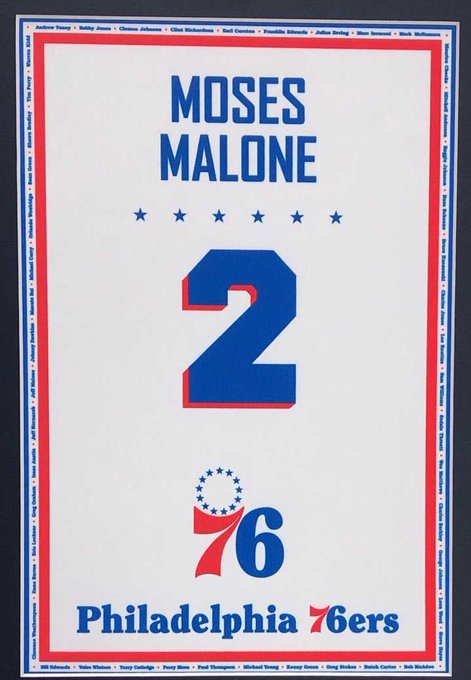
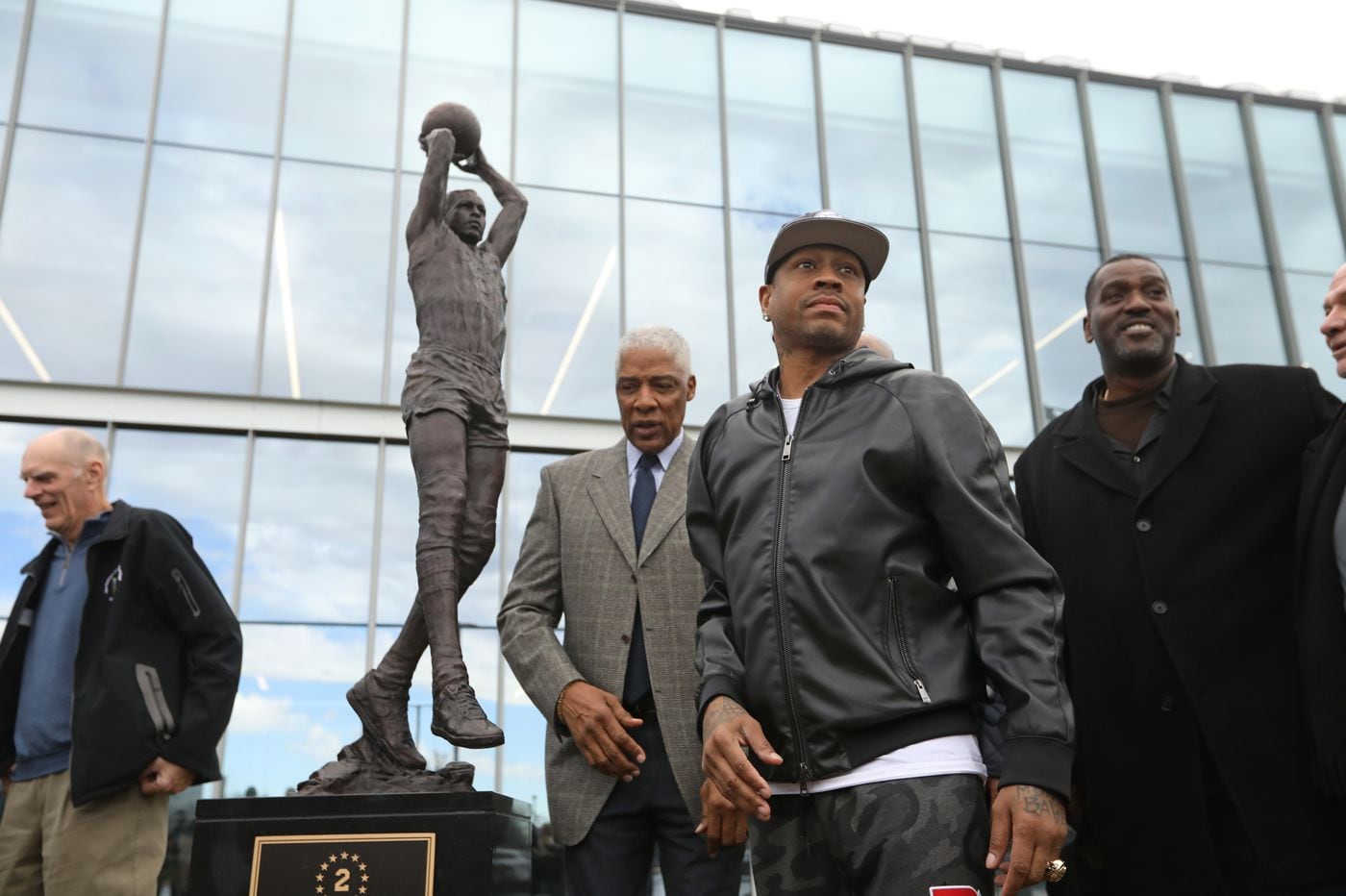
Last night, the Philadelphia 76ers raised a banner signifying the retirement of jersey #2 worn by three-time MVP Moses Malone but the banner is different from most, if not all, retired jersey banners: per Malone's request, the banner includes the names of all 48 of his Philadelphia teammates--not just the members of the 1983 NBA championship team, but every single person who played for the team during his five seasons with the organization (1983-86, plus a curtain call in 1994). The 76ers also honored Malone with a statute placed on their Legends Walk near their Camden, New Jersey practice facility. Other 76ers who have been honored with Legends Walk statues are Wilt Chamberlain, Billy Cunningham, Hal Greer, Julius Erving and Maurice Cheeks
Here is a picture of the banner, and a picture of the statue, with (left to right) Bobby Jones, Julius Erving and Allen Iverson among those present to pay tribute to Malone.
Malone passed away in 2015 but he would be happy that the team remembered and honored his one condition about his jersey being retired. Malone's request speaks volumes about the kind of person and teammate he was. Michael Lee wrote a nice story about Malone's career and the ceremony and some of the quotes in that piece provide meaningful context about one of the most underrated great players of all-time. His Philadelphia Coach, Hall of Famer Billy Cunningham, said, "Moses Malone is as smart a basketball player that I've ever been around." Pat Williams, the general manager who brought both Julius Erving and Moses Malone to Philadelphia, described Malone's style of play: "He wasn't beautiful. He wasn't graceful. He just outworked people. Out-hustled them. Went after every rebound. Never backed down. And we haven't seen that type of player ever again, probably never will." Maurice Cheeks recalled Malone's sense of humor; after a game during which Cheeks only made one shot, Malone quipped that he should have at least made two so that people would not assume that the one was just a lucky shot.
Unlike many of today's superstars who incessantly seek out the spotlight and demand that they are recognized as "The Man," Malone--the reigning (1982) MVP joining a Philadelphia team led by the previous (1981) MVP Julius Erving--quashed any hint of that nonsense with a simple, direct statement: "This Doc's team." Malone deservedly won the 1983 regular season MVP and the 1983 Finals MVP as the 76ers rolled to 65-17 regular season mark and then went on a record-setting 12-1 playoff run, but Malone let his play speak for itself as opposed to running his mouth. Malone and Erving each earned All-NBA First Team honors, and Erving finished fifth in MVP voting. They provided the blueprint for the way that two all-time great players should share the spotlight and the glory while leading their team to the top; it is a shame that they did not get paired together a few years earlier (Erving turned 33 during the season that Malone joined the team) or they might have won several championships in a row. Instead, they enjoyed one dominant season together, plus a strong push to the 1985 Eastern Conference Finals that ended with a defeat at the hands of the younger Boston Celtics, who were in the midst of a run of four straight NBA Finals appearances.
For a variety of reasons that fall outside the scope of this article, it is difficult to determine which basketball team is the greatest team ever but Philadelphia's 1983 championship team takes a back seat to no single season squad in pro basketball history; that does not mean that they are definitely the best, but it means you cannot point to a single team that is clearly better.
Malone was the dominant force on that dominant team, along with the incomparable Erving, and it is fitting that the 76ers honored not only Malone's greatness but that they did so in keeping with his wish to recognize all of his teammates as well.
Julius Erving's Playoff Career, Part IV: A Graceful Descent
Championship Defense Falls Short
The 1982-83 Philadelphia 76ers may be the greatest single season team in NBA history but age and injuries prevented that squad from becoming a dynasty. Julius Erving (34 years old) and Bobby Jones (32) were both well into their 30s by the time the 1984 playoffs began. In 1983-84, Andrew Toney made the All-Star team for the second straight season and he averaged a career-high 20.4
ppg, but his career lasted just four more injury-shortened seasons. In 1983, Maurice Cheeks earned the first of his four All-Star selections and he had another solid season in 1984 (12.7 ppg, 6.4 apg, 2.3 spg, .550 FG%) but his emergence was not enough to overcome the declines suffered by the team's other key players.
Moses Malone was still young chronologically (29) but he was a 10 year veteran who had entered pro basketball straight out of high school and--even though no one could have realized this at the time and even though he played until he was 39--his best years were already behind him: Malone shot at least .500 from the field and averaged at least 14 rpg in each season from 1979-83 but he never matched either of those marks for the rest of his career; in 1982-83, Malone made the All-Defensive First Team for the first (and
only) time in his career but in 1983-84 his 1.5 bpg average did not even lead his team in that
category. In 1983-84, Malone led the NBA in rebounding (13.4 rpg) for the fourth straight season while also ranking 11th in scoring (22.7 ppg) but after winning back to back MVPs he dropped to 10th in the balloting and he slipped to the All-NBA Second Team after earning First Team honors two years in a row.
Erving ranked 12th in the league in scoring (22.4 ppg) and he averaged 26.2 ppg in February 1984 when Malone missed several games due to injuries. Erving led the 76ers in blocked shots (1.8 bpg, eighth in the league) and he ranked second on the team in scoring, steals (1.8 spg, 10th in the league) and rebounding (6.9 rpg) while also ranking third in assists (4.0 apg). He posted better averages than he did in 1982-83 in every category except for blocked shots (his average remained the same but he took over team leadership from Malone, a remarkable feat for an aging small forward). Erving earned his last All-NBA First Team selection in 1983 and he made the Second Team for the final time in 1984. Of the 20 oldest players in the NBA during the 1983-84 season (ranging in age from 33 to 37), Erving ranked first in scoring, edging out the 37 year old Kareem Abdul-Jabbar (21.5 ppg). Erving and Abdul-Jabbar were the only two players on that list who averaged at least 20 ppg.
In a 1992 interview conducted by Academy of Achievement, Erving offered an interesting take on the impact that fans can have on the game and the role that psychology plays in the evolution of an elite athlete:
When the crowd appreciates you, it encourages you to be a little more daring, I think. That's probably what the home court advantage is all about. With the crowds on your side, it's easier to play up to your potential. Generally, you'll have more players on the home team playing up to their potential than on the road team. Talented people sometimes react adversely to being booed or jeered or going into a foreign arena. It takes them a little longer to get focused and to reach their full potential and to get into stride, get into sync. You'll find some teams that are good home teams that are lousy road teams because of that. The perception is that the home team will always have an advantage. When you find a team that's a great team on the road, they're generally listed as a championship caliber team, because they've been able to overcome this. This is simply one of the psychological aspects of the game, which a lot of people write about and very few people study. I don't think I began to study it until I was in my late 20s. The last eight or nine years of my career I spent more time in learning about it because that's where there was a greater learning curve available for me, versus trying to physically jump higher or shoot straighter or run faster. The psychic side opened doors for me, physically and mentally and allowed me to become a better player at an older age. In 1981, at age 31, I was voted the best player in basketball and the most valuable player in the league. That's considered old. You have a lot of guys who start out at 20 now and this was after playing for 10 years. I thought that was something that I needed to credit--understanding the psychic side of the sport versus physically going out and doing anything differently.
Clearly, Erving studied his craft--and himself--very carefully and he did everything he could to maximize his productivity as an older player but the 1983 championship proved to be the crowning point of the Erving era in Philadelphia because young dynasties were emerging in Boston and Los Angeles under the leadership of Larry Bird and Magic Johnson respectively. Bird's Celtics finished with the best record in the NBA (62-20), while Johnson's Lakers topped the Western Conference with the league's second best record (54-28). Those teams combined to win every NBA title from 1984-88, facing each other in three of those five championship series. The 76ers went 52-30 in 1983-84, the league's third best record but 10 games behind the Celtics in the Atlantic Division race.
Injuries decimated the 76ers during the 1983-84 season; they went 3-6 without Malone at one point, part of a 3-8 stretch extending from late January through mid-February that was their worst skid since a 3-10 run during February-March 1979. The 76ers even briefly dropped to a second place tie (with the Knicks) in the Atlantic Division, putting in jeopardy their streak of never falling below second place since Erving joined the team in 1976. Erving pinpointed another problem in addition to the injuries: during the 76ers' dominant 1983 playoff run four players--Malone, Erving, Toney and Cheeks--provided the bulk of the scoring while the other players had much less prominent roles but that is not sustainable during the 82 game grind of the regular season. Erving said, "Even if we had not suffered the injuries, mentally there were problems. We had developed bad habits that were directly because of our success last year."
In the first round of the playoffs, the 76ers faced the 45-37 New Jersey Nets. On paper and based on playoff experience, the 76ers superficially looked like clear favorites but the Nets went 3-3 versus the 76ers during the regular season and as soon as the teams took the court in the postseason it became apparent that the Nets were a nightmare matchup for the 76ers. Micheal Ray Richardson, a 6-5 multi-talented guard who led the NBA in assists and steals during the 1979-80 season, played some of the best basketball of his career during the 1984 playoffs; he only averaged 12.0 ppg and 4.5 apg in 48 regular season games while he battled drug addiction but during the postseason he seemed to be clean, healthy and at the top of his game (sadly, he suffered another drug relapse two years later and the NBA banned him for life). Second year power forward Buck Williams was too big and strong for Erving or Jones to guard. Center Darryl Dawkins, who never reached his full potential in Philadelphia, was eager to get some revenge against his old team.
The Nets raced to a 39-29 first quarter lead in game one at Philadelphia en route to a 116-101 win. Philadelphia cut the margin to 97-91 at the 6:56 mark of the fourth quarter but New Jersey responded with a 15-2 run. This was the 76ers' first loss in 10 playoff games and their worst playoff opening loss in 18 years, while the Nets posted the first playoff victory in the franchise's NBA history. Williams led both teams in minutes (46), points (25) and rebounds (16). Otis Birdsong scored 24 points and Richardson provided a glimpse of coming attractions with 18 points, a game-high nine assists and six rebounds. Toney had 24 points, five assists and four rebounds. Malone added 20 points and 11 rebounds but he shot just 6-14 from the field and he only scored four points in the second half. Erving contributed 18 points, a team-high eight assists and seven rebounds but he also shot poorly from the field (6-16). Cheeks, who finished with 15 points and four assists, said, "Everything they did, they did well. Everything they tried, they did exactly right."
The Nets countered the 76ers' aggressive, trapping defense by relentlessly driving to the hoop. New Jersey Coach Stan Albeck explained, "Nothing stops pressure defenses better than layups."
During the championship season, the 76ers often fell behind before rallying to win but Philadelphia Coach Billy Cunningham had emphasized throughout the 1984 campaign that the 76ers were relying too much on their confidence in their ability to overcome any deficit. He offered this blunt appraisal of the loss: "There
is not really a lot I can say. They outplayed us in every phase of the
game." Cunningham lamented his team's defensive breakdowns: "Micheal Ray Richardson was doing things to us that we don't let Magic Johnson do."
Philadelphia cruised through the 1983 playoffs with a 12-1 record but after New Jersey's 116-102 game two victory the 76ers were one loss away from being swept out of the 1984 playoffs. Richardson scored a game-high 32 points, passed for a game-high nine assists, grabbed seven rebounds and swiped four steals. He shot 12-23 from the field, including 3-7 from three point range--an outstanding percentage for a player who shot just 14-58 (.241) from behind the arc during the regular season. "We're going for a sweep," Richardson declared.
The Nets did not just beat the 76ers--they humiliated them, building a 79-55 third quarter lead. The 76ers trimmed the deficit to five points, 91-86, but Richardson nailed a three pointer and converted a three point play as the Nets pulled away again. Dawkins added 22 points, six rebounds and two blocked shots, while Williams contributed 13 points, nine rebounds and four blocked shots in a game-high 44 minutes. The Nets won the rebounding battle 42-32 and they shot .563 from the field while holding the 76ers to .451 field goal shooting. The game did not look like an upset as much as it looked like a younger, faster and hungrier team outclassing an older, slower and lethargic team. Malone led the 76ers with 25 points and 12 rebounds but he shot just 8-18 from the field (.444, well below the .536 field goal percentage he posted in the 1983 playoffs). Toney finished with 22 points on 9-16 field goal shooting but he committed seven turnovers. Cheeks and Clint Richardson scored 13 points each but Cheeks needed three stitches over his left eye after taking a hard fall in the third quarter and he did not return to action after suffering that injury. Erving added 12 points and eight rebounds but he shot just 5-13 from the field.
The 76ers avoided the sweep by winning game three, 108-100. Erving wore his championship ring to the arena, explaining to the media, "I don't usually do that. I wore it to show the team how much it takes to win it." Erving scored a game-high 27 points, including 11 in the fourth quarter and five during the 76ers' 9-0 run to finish the game. He shot 12-20 from the field and tied Cheeks for team-high honors with five assists. In an April 23, 1984 article for the New York Times, Dave Anderson described Erving's heroics:
If the 76ers do survive this series, they will remember what Julius Erving did yesterday in their moments of truth down the stretch. With his team trailing, 100-99, and 91 seconds remaining, Doctor J put them ahead and kept them ahead. In those 91 seconds, he showed why he was the only current player among the 12 selected for the NBA's 25th anniversary team. In moments of truth, some players don't want the ball. He not only wants it, but even steals it.
Anderson's lyrical words are apt, though he got some of the facts wrong: Kareem Abdul-Jabbar was the other active player selected for the NBA's anniversary team in 1981 and the anniversary being celebrated was the 35th, not the 25th (that kind of inattention to detail could perhaps explain why Anderson later praised Vincent Mallozzi's terrible Julius Erving biography).
Malone returned to form with 21 points on 8-15 field goal shooting, a game-high 17 rebounds and a game-high five blocked shots. Cheeks added 19 points, while Toney had 17 points and four assists. Williams led the Nets with 21 points and 17 rebounds in 47 minutes. Richardson finished with 16 points and 11 assists but Cheeks held him to five points and two assists in the second half. Dawkins had 16 points and six rebounds. Cunningham said, "Our object is to make it back to Philadelphia. We don't lose three in a row in Philly very often."
The 76ers achieved Cunningham's goal, winning game four 110-102. Erving and Malone each scored a game-high 22 points. Malone had 15 rebounds and three blocked shots, while Erving contributed a game-high eight assists plus five rebounds. Cheeks scored 20 points and Toney added 18 points despite shooting just 5-13 from the field. Albert King led the Nets with 20 points. Williams had 16 points and a game-high 18 rebounds. Richardson tied Erving for game-high honors with eight assists but he only scored 13 points on 6-19 field goal shooting. The 76ers built a 95-77 lead but the Nets, playing in front of a sellout crowd of 20,149 at Brendan Byrne Arena, cut the margin to 100-96 with 2:07 remaining. Bobby Jones scored a dunk and two free throws to hold the Nets at bay. Erving and Malone closed out the scoring by each sinking a pair of free throws. Erving said, "The inexperienced player's instincts are to go faster. The experienced player's instincts tell him to slow down, to gain control by maybe changing the pace. Those are the things the Nets are most lacking."
While Erving suggested that the 76ers were in the "driver's seat" now, the reality is that no NBA team had come back from a 2-0 deficit to win a five game series since Fort Wayne defeated St. Louis in the 1956 Western Division Finals. Perhaps that is why Cunningham sounded a more cautionary note than Erving: "We can't feel we've shown them anything. We won Sunday and Tuesday and can't relax now. We have to be even stronger." Cunningham also acknowledged that game four was a very tough contest: "It was as physical a game as I've seen in a long time. I'm glad it's not a seven game series. No one would survive."
After game four, Erving made an uncharacteristically brash statement, declaring that his team had not come all the way back just to "cough it up," that there was no way that the 76ers would lose and "you can mail in the stats." At first it seemed like Erving might not have to eat those words; the 76ers led game five 90-83 with 7:12 remaining but they collapsed down the stretch and lost 101-98. The 76ers had not lost three straight playoff games at home since 1969. The way that the young and physical Nets upset the defending champion was reminiscent of how the Spirits of St. Louis similarly stunned Erving's Nets in the 1975 ABA playoffs.
"Our season had more valleys than peaks and the playoff was indicative of the season--two peaks and three valleys," Erving said.
Some of the Nets' players said that veteran forwards Erving and Jones seemed tired in the waning moments, a charge that Erving declined to address. Erving scored just 12 points on 5-11 field goal shooting, though he contributed 10 rebounds, four assists and two blocked shots. After the game he said, "This is typical of the up and down season we had. I expected it to be a struggle. We forced them to play our kind of game and they responded to the challenge." He added, "The Nets made the big plays down the stretch and we didn't. They showed great character to win this series."
Richardson put on another great performance--a game-high 24 points plus six assists and six rebounds--but he also had plenty of help. Birdsong matched Richardson with 24 points and six assists, Williams had 17 points and a game-high 16 rebounds in 46 minutes and King chipped in 15 points, four rebounds and four assists. Toney led the 76ers with 22 points on 8-15 field goal shooting. Malone finished with 19 points and a team-high 14 rebounds but he again shot worse than .500 from the field (6-14). Cheeks had 16 points and a game-high seven assists but he shot just 6-15 from the field.
Richardson averaged 20.6 ppg, 8.6 apg and 5.2 rpg during the series while shooting .494 from the field in 42.4 mpg. Williams averaged 18.4 ppg and a series-high 15.2 rpg in 45.0 mpg; he shot .597 from the field and was a dominant force in the paint at both ends of the court. Malone led the 76ers in scoring (21.4 ppg) and rebounding (13.8 rpg) but he shot just .458 from the field. Toney averaged 20.6 ppg on .519 field goal shooting. Erving ranked third on the team in scoring (18.4 ppg), second in rebounding (6.4 rpg) and first in assists (5.0 apg). He also averaged 1.6 spg and 1.2 bpg. Erving shot .474 from the field and .864 from the free throw line. Cheeks, who battled various injuries throughout the series, scored 16.6 ppg on .522 field goal shooting but he only averaged 3.8 apg, tying Toney for second on the team.
One More Eastern Conference Finals Showdown Versus Boston
In Erving's final three seasons he gradually descended from elite level to "merely" All-Star status: from 1985-87 he was still one of the 15-20
best players in the league but he was no longer consistently dominant. In 1984-85, Erving set career-lows in scoring (20.0 ppg, second on the team), rebounding (5.3 rpg, third on the team) and assists (3.0 apg, third on the team). He remained potent defensively, averaging 1.7 spg (second on the team) and 1.4 bpg (second on the team). Erving was the fifth oldest player in the NBA, trailing only Kareem Abdul-Jabbar, former teammate Billy Paultz, George T. Johnson and Artis Gilmore. Of the 20 oldest players in the NBA (ranging in age from 32 to 38), Erving ranked third in scoring behind only Abdul-Jabbar (22.0 ppg) and 33 year old George Gervin (21.2 ppg). Read more »
Julius Erving's Playoff Career, Part III: Consistency, Frustration and then a Glorious Championship Run
"I've always tried to tell myself that the work itself is the thing, that win, lose or draw, the work is really what counts. As hard as it was to make myself believe that sometimes, it was the only thing I had to cling to every year--that every game, every night, I did the best I could."--Julius Erving
Julius Erving and the New York Nets did not have much of a chance to celebrate after winning their second ABA championship in three years; during the summer of 1976, the ailing ABA reached an agreement with the NBA to form--as a Sports Illustratedcover called it--"one big league" featuring "Dave" (Cowens) and "The Doctor." Four ABA teams--the Denver Nuggets, Indiana Pacers, New York Nets and San Antonio Spurs--joined the NBA at a cost of $3.2 million each; Kentucky owner John Y. Brown received a $3 million settlement for folding his franchise, while the Silna brothers--owners of the St. Louis franchise--negotiated what was later called "the greatest sports deal of all-time": instead of getting a lump sum payment in 1976, they arranged for each of the surviving ABA teams to pay them a share of NBA television revenue in perpetuity.
In addition to the $3.2 million payment to the NBA, the Nets also had to compensate the New York Knicks $4.8 million over the next 10 years as indemnification for operating in the Knicks' territory. While Nets' owner Roy Boe scrambled to put together enough cash to keep his franchise afloat, Erving declared that the Nets had promised to redo his contract if the leagues merged; Erving's sublime talents and his box office value were a major reason for the merger, so Erving understandably wanted to be properly compensated but Boe denied that he had ever made that agreement with Erving and, in any case, Boe did not have the necessary funds to pay Erving more money. Erving missed training camp and the preseason as a result of the contract dispute. Boe tried to trade Erving to the Knicks in exchange for cash plus cancellation of the indemnification payment but the Knicks refused that offer. Philadelphia General Manager Pat Williams seized the opportunity to acquire the game's best player and right before the 1976-77 season began the New York Nets sold Julius Erving to the Philadelphia 76ers in a $6 million deal, a staggering sum for that era, with roughly half of that amount paid to the Nets and the other half to Erving over the course of a six year contract.
Pat Williams' 20-20-20 Vision
Erving joined a Philadelphia team that already had two All-Stars: forward George McGinnis (who shared 1974-75 ABA MVP honors with Erving before jumping to the NBA) and guard Doug Collins. Erving explained the situation to this writer: "The first day that I reported to Philadelphia, Pat Williams said, ‘We are going to be a really good team, but we really need to have three guys scoring 20 points. We don't need anybody scoring 30 points on our team.' He said, 'You, Doug Collins and McGinnis can be 20 point scorers for us and that will make us a better team.' That was a specific conversation. Hey, I had no problem scoring (only) 20 points. I’m trying to collect the 'Ws.' I had already been on title teams in the ABA and we thought that this would bring us to the championship."
The 76ers started out 0-2 before winning four straight games to take over first place in the Atlantic Division, a position that they maintained the rest of the way (save for a couple days when they slipped a half game behind Boston) en route to a 50-32 record and the franchise's first division title since 1968. The 76ers were maligned as a run and gun, one on one offensive team that did not play defense but they ranked first in the league in blocked shots, third in the league in defensive field goal percentage and fourth in the league in defensive rebounds. Erving made a strong contribution at that end of the court, ranking second on the team in defensive rebounds (6.1 drpg), steals (1.9 spg) and blocked shots (1.4 bpg).
Erving instantly turned the 76ers into the biggest gate attraction in the NBA. The 76ers improved to 1-2 with a 110-101 win over the New Orleans Jazz in front of an NBA-record crowd of more than 27,000 in the Louisiana Superdome. The next night, Erving scored 27 points (tying McGinnis for game-high honors) in a 116-94 win at Houston, playing before a crowd of 15,676--the best attendance ever for an NBA game in Texas. Only 5832 fans showed up for the Nets' NBA home debut without Erving but a few days later 18,116 fans packed the Spectrum to watch Erving's 76ers improve to 3-2 after pounding his former team 104-80.
Erving finished fifth in the MVP balloting; he led the 76ers in scoring (21.6 ppg, 15th in the NBA) and the team came close to achieving the 20-20-20 balance that Williams wanted: McGinnis averaged 21.4 ppg (16th in the NBA) and Collins averaged 18.3 ppg despite missing 24 games due to injuries. Erving averaged 8.5 rpg (second on the team), and 3.7 apg (fourth) in addition to his aforementioned defensive contributions; he was still an excellent all-around performer but his per game statistics declined across the board because he played fewer minutes than he had played in his first five seasons. Erving's rebounding average was 2.2 rpg lower than his lowest ABA rebounding average but it turned out to be the highest rebounding average of his NBA career. This is not unusual; as the following chart shows, most of the top 10 rebounders in pro basketball history (based on rpg average) posted their best rebounding average early in their careers:
Rank Player Career RPG average/Best RPG average (season)
1) Wilt Chamberlain 22.89/27.2 (second season)
2) Bill Russell 22.45/24.7 (eighth season)
3) Bob Pettit 16.22/20.3 (seventh season)
4) Jerry Lucas 15.61/21.1 (third season)
5) Nate Thurmond 15.00/22.0 (fifth season)
6) Mel Daniels 14.91/18.0 (fourth season)
7) Wes Unseld 13.99/18.2 (first season)
8) Walt Bellamy 13.65/19.0 (first season)
9) Dave Cowens 13.63/16.2 (third season)
10) Elgin Baylor 13.55/19.8 (third season)
Selected Others:
50) Larry Bird 10.00/11.0 (fourth season)
111) Julius Erving 8.47/15.7 (first season)
176) Magic Johnson 7.24/9.6 (third season)
222) Michael Jordan 6.22/8.0 (fifth season)
Rebounding is a skill set that does not tend to improve with age/experience, at least at the professional level. It is important to note that even Erving's reduced NBA rebounding averages still annually ranked among the best at the small forward position.
The 1976-77 season shattered any old guard NBA pretense about the ABA being inferior; ex-ABA players accounted for four of the NBA's top 10 scorers, two of the top four rebounders and 10 of the 24 All-Stars. Erving won the All-Star Game MVP, one of the few individual honors that he did not capture during his ABA career. Indiana Pacer Don Buse led the league in assists and steals. Five of the starters in the NBA Finals began their careers in the ABA: Julius Erving, George McGinnis, Caldwell Jones, Maurice Lucas and Dave Twardzik. David Thompson made the All-NBA First Team, while Erving, McGinnis and George Gervin made the All-NBA Second Team. The Nuggets and Spurs kept their rosters intact and immediately became perennial playoff
teams; the Nets understandably had to rebuild after Erving's departure, while the Pacers similarly had to rebuild after the core players from their three
championship teams aged, retired or finished their careers on other
teams.
The 76ers earned a first round bye and then faced their old rival the Boston Celtics in the Eastern Conference semifinals. The Celtics were the defending NBA champions but the 76ers enjoyed home court advantage because the Celtics only went 44-38 in the regular season. Erving scored a game-high 36 points in the series opener, including a dunk with eight seconds left in regulation to tie the score at 111--but after being fouled on that play he missed both free throws in a two to make one penalty situation. Jo Jo White missed a jumper and the game seemed to be headed to overtime after Erving blocked Sidney Wicks' shot but the ball bounced to White, who hit the game-winning jumper from the left baseline as time expired. White scored 21 points in the Celtics' 113-111 victory. "I feel empty," Erving said after the game. "We came here to win and we don't have anything. We are 0-1." However, Erving also noted that even if he had completed the potential three point play, "We would have lost by one instead of two." Erving's former Virginia teammate Charlie Scott led Boston with 22 points.
In a battle pitting a veteran future Hall of Fame forward against a Hall of Fame forward in his prime, 37 year old John Havlicek poured in a game-high 31 points on 11-25 field goal shooting but the 27 year old Erving had 30 points on 14-24 field goal shooting as the 76ers evened the series with a 113-101 victory. Havlicek also had nine rebounds and six assists, while Erving countered with six rebounds and four assists.
Erving scored a game-high 27 points as Philadelphia reclaimed home court advantage with a 109-100 game three win in Boston. Collins added 25 points and Lloyd Free--he had not yet legally changed his first name to World--scored 22 points on 9-13 field goal shooting in just 18 minutes. The Celtics had not lost at home in the playoffs since 1975, a 13 game streak. Havlicek led the Celtics with 25 points.
Dave Cowens had 37 points and 21 rebounds for the Celtics--including 23 first half points on 10-10 field goal shooting--in Boston's 124-119 game four win. Collins led the Sixers with 36 points, McGinnis added 27 and Erving had 23. White contributed 26 points, nine assists and seven rebounds. Havlicek only scored 12 points but he dished off for 15 assists.
The 76ers achieved Pat Williams' 20-20-20 balance in game five at home--but the third member of the 20 point trio was Steve Mix, not McGinnis: Collins (23 points), Erving (22) and Mix (20) led the way as Philadelphia took control of the series with a 110-91 win. Scott topped Boston with 20 points.
The proud Celtics forced a seventh game as both White and Havlicek played all 48 minutes to carry Boston to a 113-108 game six win. White scored a playoff career-high 40 points and Havlicek added 25 points. Collins led the Sixers with 32 points, McGinnis scored 22 points and Erving had an off game with just 14 points on 7-20 field goal shooting.
The first six games of the series were high scoring and free wheeling but game seven was a grind it out slugfest. Free missed his first six field goal attempts before scoring a game-high 27 points on 10-27 field goal shooting as his 76ers outlasted the Celtics 83-77. McGinnis scored 22 points before fouling out. Erving contributed 14
points on 6-19 field goal shooting and he also had eight rebounds. Erving said, "Our bench and depth was the key to the win. We had more
depth than they did. I never thought the starters would neutralize each
other as much as they did." Collins was the only other 76er who scored in double figures (10 points on 3-11 field goal shooting). White led the Celtics with 17 points on 7-24 field goal shooting but he did not score in the second half. Cowens pulled down a game-high 27 rebounds and blocked three shots but he only scored 11 points on 5-16 field goal shooting. This was just Boston's second loss in 13 seventh games.
Erving and Collins each scored 166 points (23.7 ppg) versus Boston. In his first NBA playoff series, Erving averaged 6.1 rpg, 2.7 apg, 1.9 spg and 1.3 bpg while shooting .464 from the field and .800 from the free throw line. This was the first time in 10 career playoff series that Erving averaged less than 26.0 ppg but he decisively won his matchup with Havlicek, outscoring his rival in five of the seven games (Havlicek averaged 19.9 ppg). McGinnis averaged 15.6 ppg and shot just .380 from the field.
Philadelphia faced the 49-33 Central Division champion Houston Rockets in the Eastern Conference Finals. The 76ers led 100-81 with 28 seconds remaining in the third quarter of game one but the Rockets cut the margin to 120-113 late in the fourth quarter before Erving hit a jumper and two free throws to seal Philadelphia's 128-117 win. Erving led the 76ers with 24 points, Collins added 23 points and McGinnis finished with 21 points, 13 rebounds and six assists. Erving said, "I thought we were capable of getting good shots any time we wanted. If we rebound and go to the boards like we did, we can run.
If we do, we'll continue to win."
Moses Malone poured in a game-high 32 points but he only scored 10 points in the second half as McGinnis--not known as a staunch defender--used his brawn to knock young Malone off of his favorite spot in the post. Houston Coach Tom Nissalke declared that Erving and McGinnis comprised "the best two players on one team in the league."
In game two, the 76ers' three star attack flourished again; this time McGinnis led the way with 21 points while Collins scored 20 points and Erving added 18 points as Philadelphia won 106-97. Malone only had seven points but Calvin Murphy (32 points) and Rudy Tomjanovich (22 points) picked up the slack.
When the series shifted to Houston, Malone returned to his dominating form with 30 points and 25 rebounds as the Rockets cruised to a 118-94 game three victory. This was the second of Malone's five 30-20 playoff games as a Rocket. Nissalke called Malone "the best rebounder in the game today" and Nissalke predicted, "In three years he will be one of the best players in the game"; Malone fulfilled that prophecy in 1978-79 when he won the first of his three MVPs. Nissalke changed his starting lineup for game three, replacing Goo Kennedy with the seven footer Kevin Kunnert. Kunnert responded with 12 points and 14 rebounds as the bigger Rockets won the rebounding battle 59-34 and slowed the 76ers' fast break to a crawl.
Erving led the 76ers with 28 points and he also had six assists but McGinnis only had 15 points on 6-18 field goal shooting and Collins scored nine points on 4-12 field goal shooting. "They killed us on the boards, they shot a lot better than we did, they had more control of the game than we did and they won the game," Erving said. "It might have been that we were lackadaisical or it might have been good defense. We were too liberal with the ball. We pushed it up fast, went for the jumper and missed it. The first two games we made it."
Free left the game in the second quarter with a bruised rib cage, an injury that would limit him for the rest of the postseason.
The 76ers' running game was back in high gear in game four and they raced to a 107-95 win to take a 3-1 series lead. Collins scored 36 points--including 10 straight points during the decisive fourth quarter run--and Erving added 29 points. Kunnert had another strong game (21 points, 17 rebounds) but an ineffective Malone only scored five points. Rudy Tomjanovich led the Rockets with 24 points.
The Rockets overcame Erving's 37 point explosion to avoid elimination, sending the series back to Houston after a 118-115 game five win. The 76ers squandered an 84-69 third quarter lead. John Lucas and Tomjanovich each scored 21 points.
Houston led for most of game six until Darryl Dawkins and Mike Dunleavy hit consecutive baskets to put Philadelphia on top 91-87 near the end of the third quarter. Dawkins, who jumped to the NBA straight out of high school in 1975, scored 13 of his 20 points in the third quarter. The 76ers pushed the lead to 104-97 with 5:27 remaining in the fourth quarter but then they went scoreless for three minutes, allowing the Rockets to make one final rally. Erving broke that drought with a basket and two free throws to make the score 108-105 and then Houston countered with hoops by John Lucas and Mike Newlin. Henry Bibby made what turned out to be the game-winning shot with :37 remaining. Lucas' driving layup with five seconds left was disallowed by Jake O'Donnell, who ruled that Lucas had charged into Collins. Erving scored a game-high 34 points, snared nine rebounds and dished off for six assists in the 112-109 win. Collins added 27 points. Free did not play due to his rib injury and a
partially collapsed lung. Lucas led the Rockets with 24 points.
"They didn't come out with any of that cheetah stuff," said Nissalke, referring to the 76ers' fast break attack. "They were coming down and setting up and shouting, 'Where's Doc?' It's unbelievable that a team that has lived and died by the fast break would run set plays like that, but he's the best forward who has ever played the game."
Erving averaged 28.3 ppg, 6.3 rpg, 6.0 apg, 2.0 spg and 1.2 bpg versus Houston in the Eastern Conference Finals while shooting .570 from the field and .800 from the free throw line. Erving's rebounding was below the standard he set during his ABA career but in all other statistical categories his performance mirrored his outstanding all-around production in his three previous "Final Four" (Division Finals/Conference Finals) appearances. Collins averaged 23.5 ppg and shot .604 from the field. McGinnis averaged 13.7 ppg and shot just .353 from the field. Malone averaged 17.2 rpg in the Eastern Conference Finals, the best rebounding performance in a series in franchise history at that time (Malone later surpassed that mark twice).
Philadelphia faced the Portland Trailblazers in the NBA Finals. Portland center Bill Walton finished second to the L.A. Lakers' Kareem Abdul-Jabbar in the MVP voting, earned a spot on the All-NBA Second Team and beat out Abdul-Jabbar for All-Defensive First Team honors. Walton led the NBA in rebounding (14.4 rpg) and blocked shots (3.2 bpg). Portland finished second in the Pacific Division with a 49-33 record but defeated the 53-29 Pacific Division champion Lakers 4-0 in the Western Conference Finals.
Philadelphia Coach Gene Shue closed the team's practices to the public and the media prior to game one. Asked if Shue did this out of secrecy, a 76er official quipped that Shue did it because of "embarrassment" (the 76ers were not known for their diligent practice habits, something that irritated the hard-working Erving)--but once game one of the NBA Finals began it became clear what the 76ers had been hiding: the 76ers nullified the aggressive trapping of Portland's guards by having center Caldwell Jones bring the ball up the court. After Philadelphia's 107-101 win, Shue explained, "The strength of the Portland team is in the pressure their guards apply, so we attacked them at their weakest link."
"It was a good tactic," Portland Coach Jack Ramsay admitted. "It worked very effectively. We tried several things against it, but none worked very well." Ramsay also said that to win the series Portland had to hold the Erving-McGinnis-Collins trio to around 60 total points.
"This is what I call net cutting time," Erving said. "The playoffs--I love them. This is the best time of year, what we work for all winter. Not everybody gets the chance to be here and as long as I'm here I'm going to do something. I'm going to make my presence felt."
Erving scored a game-high 33 points, shooting 14-24 from the field and making all five of his free throws. He also had five rebounds, four assists and three steals. Collins had a similar stat line: 30 points, 12-23 field goal shooting, 6-6 free throw shooting, six rebounds, six assists, two steals. McGinnis scored just eight points on 3-12 field goal shooting in 22 foul-plagued minutes and his game one struggles foreshadowed what would become one of the major stories of the series. Walton's performance also provided some foreshadowing: he produced 28 points, a game-high 20 rebounds, three assists and two blocked shots. Portland committed 34 turnovers, an astounding total for any game, let alone game one of the NBA Finals. Philadelphia also enjoyed the advantage from the free throw line, shooting 27-32 compared to Portland's 15-18.
Collins scored a game-high 27 points as the 76ers took a 2-0 lead with a 107-89 win. Erving added 20 points, four rebounds, four assists and five steals. Bibby scored all 15 of his points in the first half as the 76ers built a 61-43 lead and he finished with a game-high 11 assists. "People put us down all the time," Bibby said. "They say we're a bunch of one on one players, we can't play team ball, we don't execute our plays well, we can't do the job on defense. They keep saying it--but we keep winning."
Erving added, "A lot of people think that we're a bunch of renegades. They think that a good, well-drilled team can run us apart. We are trying to prove them wrong. Portland is very singular in its offensive strategy. There is one basic play they like to run 75 percent of the time--they set up Walton in the pivot and then try to free their cutters for layups. We know this, we've drilled against it and we've been able to stop it."
Walton led Portland with 17 points and a game-high 16 rebounds. Portland turned the ball over 29 times.
In the fourth quarter, Dawkins threw Portland small forward Bobby Gross to the court as they battled for a loose ball. Dawkins took a swing at Gross but missed him and instead connected with Collins, who needed stitches above his right eye after the game. As the officials tried to restore order--not just among the players but also among dozens of fans who came on to the court--Portland power forward/enforcer Maurice Lucas came up behind Dawkins and hit Dawkins in the head. Dawkins and Lucas squared off to fight but emerged unscathed after several wild punches failed to connect. Both players were ejected; NBA Commissioner Larry O'Brien fined Dawkins and Lucas $2500 each but did not suspend either player. That skirmish may have initially seemed like just an afterthought--tensions erupting in a blowout game as one team takes a seemingly commanding 2-0 series lead--but in retrospect the entire tide of the series turned. The Blazers pulled together and rallied, while the 76ers--an emotionally fragile group under the best of circumstances--fell apart the rest of the way, a development that would have seemed improbable after their two impressive victories. Dawkins ripped a urinal off of the wall in the locker room and later expressed disappointment that none of his teammates had warned him about Lucas' sneak attack.
Enjoying the comforts of home after suffering two brutal road losses, the Blazers ambushed the 76ers in the first quarter of game three, taking a 32-12 lead. The 76ers battled back to only trail by four in the fourth quarter but Walton's consecutive hoops ignited a 26-10 run to put the game away. Portland won 129-107, their 16th straight victory at Memorial Coliseum and their 44th in 49 games (regular season and playoffs). The Blazers slashed their turnover total to 16 and Walton dominated at both ends of the court: 20 points, 18 rebounds, nine assists, four blocked shots, two steals. Lucas scored a game-high 29 points and he swiped 12 rebounds. Erving paced the 76ers with 28 points and five assists while also grabbing 11 rebounds but he received little help from anyone other than Collins (21 points on 9-13 field goal shooting). McGinnis scored 14 points on 6-17 field goal shooting, though he did contribute a team-high 12 rebounds.
If the 76ers thought that a 22 point blowout loss would be the low point of the series then they were sadly mistaken. The Blazers made nine of their first 10 field goal attempts in game four, sprinted to a 19-4 lead and never let the 76ers get closer than 11 points the rest of the way, cruising to a 130-98 win. During garbage time, the Portland reserves pushed the margin to 41 (126-85). Speedy guard Lionel Hollins scored a game-high 25 points for the Blazers, while Lucas (24 points, 12 rebounds, four assists) and Walton (12 points, 13 rebounds, seven assists, four blocked shots) controlled the paint. Erving, who led Philadelphia with 24 points, did not like his team's mindset: "We got to challenge the other team. Be aggressive. Get some big axes and chop arms and
legs." No other 76er scored more than 15 points and McGinnis was almost invisible (five points, six rebounds, 2-8 field goal shooting).
Game five started out very much like game four; the Blazers took a 16-9 lead as the 76ers missed 11 of their first 14 field goal attempts. The Blazers led by 22 points in the fourth quarter but this time the 76ers rallied, cutting the margin to 101-96 after Joe Bryant's long jumper with 3:26 remaining. Lucas countered with a jumper and then Hollins' layup extended the lead to nine. The Blazers won 110-104 to move within one victory of the young franchise's first NBA title. Gross led Portland with 25 points, Lucas added 20 points and 13 rebounds and Walton dominated inside (14 points, 24 rebounds, two blocked shots). Erving poured in a game-high 37 points, grabbed nine rebounds and passed for a team-high seven assists but only three other 76ers scored in double figures--and none of them shot better than .400 from the field.
The 76ers led 22-18 in the first quarter of game six before the Blazers went on a 39-20 run. Portland led 67-55 at halftime. The 76ers stayed in contact throughout the second half and then pulled to within two points after McGinnis' jumper with :18 left in the fourth quarter. McGinnis then tied up Gross for a jump ball and won the tap. The 76ers missed three potentially tying shots in the waning seconds--by Erving, Free and McGinnis--as Portland held on for a 109-107 win. Walton posted one of the most awesome stat lines in Finals history--20 points, 23 rebounds, eight blocked shots, seven assists--and he was selected as the Finals MVP. Gross led Portland with 24 points, while Hollins chipped in 20 points. Lucas had a very solid game (15 points, 10 rebounds, five assists, four steals).
Erving authored the first and only 40 point game of his NBA playoff career (he scored at least 40 points in seven of his 48 ABA playoff games). In addition to his 40 points on 17-29 field goal shooting, Erving had a game-high eight assists plus six rebounds and two steals. McGinnis broke out of his long playoff slump with 28 points and 16 rebounds but Caldwell Jones was the only other 76er who scored in double figures (10 points on 5-8 field goal shooting).
Erving averaged 30.3 ppg, 6.8 rpg and 5.0 apg in the NBA Finals. He shot .543 from the field and .857 from the free throw line. His 2.7 spg is still a record for a six game NBA Finals. Collins scored prolifically (19.7 ppg) and efficiently (.505 field goal shooting), while McGinnis was neither prolific (13.0 ppg) nor efficient (.388 field goal shooting).
According to information collected by Harvey Pollack and published in the 76ers' 1978 media guide, Erving led the team in playoff dunks (34, with a single-game high of five) and three point plays (converting 15 of 20 opportunities). Erving scored at least 20 points in 16 of Philadelphia's 19 playoff games--including each of the final 10--and he also posted six of his 11 highest scoring NBA playoff games. The 1977 postseason turned out to be Erving's most prolific NBA playoff campaign in scoring (27.3 ppg, third in the league), field goal percentage (.523) and steals (2.2 spg, fourth in the league).
Shortly after the 1977 NBA Finals ended, the New York Times' Sam Goldaper wrote, "The recently concluded National Basketball Association season will be best remembered for two significant events--the emergence of Bill Walton as one of the game's dominant centers and the proof that Julius Erving could play the game of basketball as well as anyone who had ever played before him." Read more »
Julius Erving's Playoff Career, Part II: Two Championships in Three Years with the Nets
"That was the time when I had the most fun playing basketball. Between age 21 and age 26, I genuinely was empowered with this ability to do anything that I wanted to do on a basketball court and anything that I had ever dreamed of doing."--Julius Erving, describing his ABA career
This series of articles focuses on Julius Erving's playoff career but the 1973 offseason and 1973-74 regular season significantly impacted not just Erving but the status of the ABA itself and thus what happened during that period must be described in order to place Erving's overall career in proper context. By the end of the 1972-73 season, the Virginia Squires had two future Hall of Famers on their roster--Julius Erving and George Gervin--but the cash-strapped franchise did not have the financial resources to retain the services of either player. Erving, dissatisfied with the terms of his original contract with the Squires, tried to jump to the NBA's Atlanta Hawks after his 1971-72 rookie campaign but a court ruling forced him to play for the Squires in 1972-73. The Squires realized that they could not keep Erving for the long term, so in the summer of 1973 they traded him to the New York Nets with Willie Sojourner for George Carter and $1 million cash. Nets' owner Roy Boe also compensated the Hawks. Several years later and after much legal wrangling, the Milwaukee Bucks (the team that owned Erving's NBA rights by virtue of selecting him in the 1972 NBA Draft) received two draft picks plus cash from the Hawks. Gervin started the 1972-73 season with the Squires and made the All-Star team for the first time but the Squires then traded him to the San Antonio Spurs. The Spurs soon shifted Gervin from forward to guard and he won four scoring titles after the ABA-NBA merger, setting a record for guards that lasted until Michael Jordan captured 10 scoring crowns.
It was a coup for the ABA that Erving not only stayed in the younger league but that he ended up in New York; the ABA was starving for more media coverage and now arguably the sport's best player had arrived on a huge stage after spending two years in Virginia. Steve Jones, three-time ABA All-Star and respected pro basketball
analyst, told Terry Pluto (as quoted on p. 319 of Pluto's 1990 book Loose Balls), "When a player as gifted as Julius takes the court, he believes that he has no limitations. He can try any move because he can make any shot. I guarded Julius when he was in that stage of his career; it wasn't much fun. If you put him in historical perspective, the only other player in
the same class is Michael Jordan. Michael has a much better jumper than
Julius but, believe it or not, Julius played much higher above the rim
and was a far better rebounder than Michael. It would be fun to see a
young Erving play a young Jordan just to see how it came out, because
those two guys are players who have no limits." With Erving in New York, the Nets in particular and the ABA in general had to be taken a lot more seriously. Erving denied feeling any extra pressure because of the size of his contract or the attention he would receive in the world's biggest media market: "I put the most pressure on myself because of my ambitions to be the best basketball player ever,"
Erving said. "What happens around me can't put any more pressure on me
than that."
The Nets started out 4-1 in the 1973-74 season before losing nine in a row and falling into last place. Kevin Loughery, who replaced Lou Carnesecca on the Nets' bench prior to the season after Carnesecca returned to St. John's University, initially wanted to use a full court pressing and trapping defensive scheme that took advantage of the athleticism of Erving and other New York players--but the system relied too much on Erving playing like Superman and Erving was feeling all too mortal due to the tendinitis afflicting his knees, the first time he had experienced such a problem. Loughery quickly realized his mistake, as recounted in this quote from Marty Bell's The Legend of Dr. J: "My original concept seemed perfectly suited to the Doctor. He plays so hard, so fast. But no one could play that way for 84 games. By the third week of the season I had run him into the ground. I was in the process of destroying the best player on my team, maybe in the game" (pp. 94-95 of the 1981 updated and expanded Signet version of Bell's classic book, the best Erving biography). Loughery called a team meeting and admitted that his coaching errors had cost the team. He tweaked the defense--reverting to a sagging man to man with zone principles that enabled Erving to freelance but did not require Erving to wear himself out--and devised ways to get Erving the ball on the move so that Erving did not have to create so much offense one on one against a set defense. Loughery also inserted muscular rookie guard John Williamson into the starting lineup. The Nets lost 107-105 at San Diego but then they won 19 of their next 22 games.
Erving's quiet, thoughtful leadership played a big role in the team's success. Erving said, "The reputation of the Nets last year was that if you got up on them early they'd start squabbling among themselves. They were losers. From the minute I knew I was coming here I was preparing myself to stop that from happening again. I knew I'd have leadership responsibilities, not as the designated leader--that's the role of the team captain, Bill Melchionni--but on a different basis. There has to be criticism among players on a team, but I guess what I've tried to do is make it constructive and cut down on meaningless griping at each other. I don't think you should cuss at a guy for missing a pass. You should boost him up by saying something like, 'It's all right. We'll get it next time.'"
In 1973-74, Erving's scoring average dropped from 31.9 ppg to 27.4 ppg but he won his second consecutive scoring title while also ranking third in blocked shots (2.4 bpg), third in steals (2.3 spg), sixth in assists (5.2 apg), seventh in rebounding (10.7 rpg) and ninth in two point field goal percentage (.515). Erving made the All-ABA First Team for the second year in a row and won the first of three straight regular season MVP awards. He played a major role in the Nets' improvement from 30-54 to 55-29, the best record in the league; the Nets accomplished this despite having the youngest starting lineup in pro basketball (average age of 22.6 years old, according to the January 14, 1974 Sports Illustrated).
In the first round of the playoffs, the Nets faced the Squires, who fell to 28-56 without Erving and Gervin but still qualified for the playoffs as eight of the 10 ABA teams participated in postseason competition. Erving battled foul trouble but still scored a game-high 24 points as New York beat Virginia 108-96 in game one. He also had nine rebounds and a game-high 12 assists. Virginia guard Roland "Fatty" Taylor was ejected at the 6:13 mark of the first quarter after hitting John Williamson with two forearm shots to the back of the head; Taylor claimed that Williamson had elbowed him first. Virginia Coach Al Bianchi was ejected in the third quarter.
Erving scored a game-high 35 points while also contributing six rebounds and five assists as the Nets cruised to a 129-110 victory to take a 2-0 series lead. The Squires cut the margin to 2-1 with a 116-115 win at home after Erving missed a last second shot and Mike Gale failed to convert a putback attempt at the buzzer. Jim Eakins scored a game-high 31 points for the Squires, while Erving led the Nets with 29 points in addition to pulling down 12 rebounds and passing for three assists.
Rookie forward Larry Kenon scored a game-high 25 points and had a game-high 11 rebounds while Erving and Williamson added 21 points each as the Nets blew out the Squires 116-88 to take a 3-1 series lead. Erving added nine rebounds and tied Gale for team-high honors with five assists. Kenon led the Nets in scoring in game five with 22 points and Erving contributed 21 points, six rebounds and five assists (tying second year guard Brian Taylor for the team lead) as New York advanced to the second round with a 108-96 win. Erving averaged 26.0 ppg against Virginia, his lowest scoring average in the first four playoff series of his career.
In the Eastern Division Finals, the Nets faced a much bigger challenge: a Kentucky team that posted the second best record in the league (53-31) thanks largely to the efforts of two future Hall of Fame big men, Artis Gilmore and Dan Issel. Erving scored a game-high 35 points and had eight rebounds as the Nets beat the Colonels 119-106 in game one. The Nets only led 52-51 at halftime but Erving scored 13 third quarter points as the Nets widened the margin to 90-75. Kenon added 20 points and a game-high 15 rebounds, while Issel scored 22 points and Gilmore contributed 13 points and 10 rebounds.
Erving scored a game-high 27 points and had six rebounds as New York cruised to a 99-80 game two victory. Reserve forward Wendell Ladner, who the Nets acquired from Kentucky in a midseason trade, contributed 15 points, 14 rebounds, five assists and five steals in just 29 minutes.
The Nets took command of the series in game three with an 89-87 win. Erving scored a game-high 30 points and he also grabbed 14 rebounds. New York held Kentucky scoreless for more than six minutes in the fourth
quarter. Issel led the Colonels with 26 points, while Gilmore
contributed 15 points, 27 rebounds and five blocked shots. Erving scored eight of New York's final 12 points, including a dunk that gave the Nets their first lead of the game (83-81) and a 20 foot game-winning jumper at the buzzer. Terry Pluto's Loose Balls contains a quote (p. 284) from Dave Vance about Erving's game-winning shot:
I was the GM of the Colonels when Julius made that shot, and Kevin tells a great story about what went on in that huddle.
When
they called time-out with 15 seconds left, Kevin went down on his knee
and started to draw up a play. He didn't get very far when this huge
hand landed on his shoulder.
"Kevin," said Julius. "I'll take the last shot."
Kevin said he got chills when he heard Doc say that. It was almost like the voice of God.
So Kevin said, "Okay, guys, if Doc misses--"
The hand came back on Kevin's shoulder and Julius said, "Kevin, I won't miss."
That just stopped Kevin. Finally, he said, "Okay, let's get Doc the ball and let's go."
I can still see Julius floating to the right in the air, the shot leaving his hand, and he just ran right into the dressing room after he let it go. Julius knew it was in and he knew he had won the game.
Erving capped off a great series by once again leading both teams in scoring, dropping in 27 points on 13-22 field goal shooting and controlling eight rebounds as the Nets won 103-90 to complete the sweep and advance to the ABA Finals. Erving scored 19 first half points as the Nets built a 64-49 halftime lead before cruising to victory. Kentucky Coach Babe McCarthy said, "Now I think the Nets are the best team I've seen in the ABA. You can talk about their inexperience but Julius Erving has three years of it and he rises to the occasion." Erving averaged 29.8 ppg, 9.0 rpg and 3.0 apg in his second "Final Four" appearance in three professional seasons.
Basketball Hall of Famer Adolph Rupp, who had recently retired as the coach at the University of Kentucky and who served as Vice President of the Board for the Kentucky Colonels, was very impressed by Erving: "Up until now I always thought that Jerry West was the greatest basketball player I ever saw, with Oscar Robertson right behind him, but I think right now that Julius Erving is the best." Rupp also
called Erving "the Babe Ruth of basketball."
The Utah Stars defeated the two-time defending ABA champion Indiana Pacers in seven games in the Western Division Finals to earn the right to face the Nets. The Stars led the ABA in two point field goal percentage (.493) and free throw percentage (.789) in the 1973-74 season. Utah's lineup included three 1974 ABA All-Stars: All-Defensive Team forward Willie Wise plus guards Ron Boone and James Jones. Jones made the 1974 All-ABA First Team, ranking second in the league in two point field goal shooting during the regular season (.551). Jones led the ABA in playoff two point field goal percentage with a blistering .581 mark, a sensational figure for a guard. He ranked fifth in the league in assists during the regular season (5.2 apg) and he improved to third during the playoffs (5.4 apg). Boone and Wise each received All-ABA Second Team honors. Zelmo Beaty, a two-time NBA All-Star who earned three straight ABA
All-Star selections as well (1971-73), was hampered by some injuries but
still averaged 13.4 ppg and 8.0 rpg during the regular season. Former ABA All-Star (1970) Gerald Govan led the team in rebounding (8.8 rpg) during the regular season and he ranked fourth in the ABA in playoff rebounding (13.7 rpg). The Utah Stars had a lot of talent and versatility; Wise may have been the best defensive forward in pro basketball at that time and the Boone-Jones duo comprised one of the top backcourts in either league. Utah went 51-33 in the regular season, the best record in the Western Division and the third best record in the league behind New York and Kentucky.
It is important to understand just how good the Stars were in order to fully appreciate what Erving and the Nets accomplished in the 1974 ABA Finals. In game one, Erving scored 47 points on 19-29 field goal shooting while also contributing 10 rebounds, three assists, two steals and one blocked shot as the Nets beat the Stars 89-85. Erving made 13 straight shots from the field and he scored 12, 14 and 15 points respectively in the first three quarters, mounting a serious challenge to the ABA single game playoff scoring record (53 points, a mark Erving already shared with Roger Brown). Kenon, the only other Net to score in double figures, came up big with 18 points and a game-high 20 rebounds, including nine offensive rebounds. Jones led Utah with 25 points; he made six shots in a row but late in the game the Nets shut him down by switching Erving on to him defensively. Beaty did not play due to a groin injury but the Stars still had four players score at least 12 points.
The Stars came out fighting in game two--literally: less than a minute after the opening tip, Boone decked Taylor, who got up off the ground and punched Boone in the face. Pro basketball was a much rougher game back then; neither player was ejected or even received a technical foul. The Nets raced to a 61-37 halftime lead en route to a 118-94 victory. Erving scored a game-high 32 points on 12-21 field goal shooting and he had another solid floor game: nine rebounds, four assists, three steals, three blocked shots. Kenon only scored six points but he once again controlled the boards, grabbing a game-high 13 rebounds. Jones and Wise led the Stars with 19 points each.
Beaty returned to action in game three, scoring 22 points and grabbing a game-high 16 rebounds as the Stars outrebounded the Nets for the first time in the series. Utah built a 15 point fourth quarter lead but the Nets stormed back to force overtime after Taylor hit a buzzer beating three pointer to tie the score at 94. Erving and Kenon each scored four points in the overtime as New York won 109-103. Erving led the Nets with 24 points and 13 rebounds and his seven assists trailed teammate Mike Gale by one for game-high honors but Erving also committed six turnovers while shooting just 9-22 from the field and 6-11 from the free throw line. Jones had 28 points, nine rebounds and six assists, while Wise not only played strong defense against Erving but he also contributed 20 points and 12 rebounds. Kenon (18 points, 12 rebounds) and center Billy Paultz (17 points, 12 rebounds) were two of the six Nets who scored in double figures.
The Stars avoided the sweep with a 97-89 game four win. Jones scored a game-high 24 points, Boone added 22 points, 10 rebounds and seven assists, Beaty scored all 18 of his points in the second half, Govan grabbed a game-high 23 rebounds and Wise did an excellent job defensively against Erving while also contributing 19 points. The Stars again won the rebounding battle. Erving finished with 18 points, nine rebounds and seven assists, while Williamson and Taylor scored 17 points each. Erving shot 9-20 from the field. How unusual is it that Wise held Erving to fewer than 20 points on .450 field goal shooting? Erving eventually played a total of 33 Finals games (11 in the ABA, 22 in the NBA) and he scored at least 20 points in 31 of those games, including a streak of 26 straight 20 point games that is second in ABA/NBA Finals history to Michael Jordan's 35 game streak. Erving shot at least .500 from the field in five of his six trips to the Finals, falling short only in 1983 when he shot .469 as a 33 year old during Philadelphia's 4-0 sweep of the L.A. Lakers.
Wise scored a game-high 34 points, grabbed eight rebounds and passed for six assists while playing all 48 minutes in game five but the Nets pulled away in the fourth quarter, claiming their first ABA title with a 111-100 win. The Nets owned the boards 54-34 as Kenon led the Nets with 23 points plus 11 rebounds and Paultz scored 21 points while grabbing 12 rebounds; Erving had a quiet night offensively by his standards (20 points on 8-18 field goal shooting, four assists) but, like all great players, he found another way to make his impact felt: Erving hauled in a game-high 16 rebounds, his best rebounding performance of the 1974 playoffs. Erving felt that his individual performance in game five "was not
complete. But we won and that's what's important." Erving explained, "I
still have lots of room for improvement. The main thing I want to do is
maintain consistency. That's what I'm striving for. I don't think I'll
ever run any faster, jump any higher or shoot any better. And I don't
think my defense needs much improvement. I think I can block shots as
well as anyone in the league. But it's maintaining consistency, under
pressure, that is most important to me."
Erving averaged 28.2 ppg, 11.4 rpg, 5.0 apg, 1.8 spg and 1.4 rpg during the Finals, shooting .518 from two point range, .333 (1-3) from three point range and .750 from the free throw line. Erving led the ABA in playoff scoring (27.9 ppg) for the third time in
his three year career. He also ranked fourth in blocked shots (19),
fourth in three point field goal percentage (.455), fifth in two point
field goal percentage (.531), fifth in assists (4.8 apg), eighth in
steals (22) and 12th in rebounding (9.6 rpg), earning the 1974 ABA Playoff MVP award.
Utah Coach Joe Mullaney was very impressed by Erving: "He's just a fantastic player. He's exceptionally gifted. He's spectacular. He has a unique talent. He has that real long body, a soft touch on his shots, amazing physical equipment and he's so unselfish, something you rarely see in a player of his caliber."
Stars' General Manager Arnie Ferrin--who played for three seasons in the BAA and the NBA in the late 1940s/early 1950s--said of Erving, "He's as good a basketball player as I've ever seen. Obviously, he's the best forward in the game. We used to debate quite frequently at home whether Bob Cousy or George Mikan was the best player in the game. But now the game has changed drastically. You have to ask yourself--if you were inheriting a pro franchise--would you rather have the best forward, center or guard in the game. There is no better forward than Julius."
Wise lavishly praised his adversary, saying that it was a "beautiful feeling" being on the court with Erving and adding, "He's basketball at it's best."
Erving appreciated all of the compliments but declined to compare himself to the legends who preceded him: "When my career is all over, then they can judge me. Then it will mean something." Erving said that he planned to play for seven more seasons. "That would give me 10 seasons. I'll be 31 then. I don't want to play as long as Oscar Robertson, Jerry West or Wilt Chamberlain. I want to play as long as I can be a positive factor. Then I'll hang it up." It is interesting that one can find similar quotes from other great players, including Michael Jordan--who was just starting his career when a 37 year old Erving was playing his final season--and Kobe Bryant. Jordan swore that he would not stick around as long as Erving did and Bryant has recently said that he will probably retire when his current contract is through. The reality is that if a player is healthy enough to extend his career then the love of the game combined with the inevitable increases in player salaries make it very difficult to walk away from the sport.
The 1973-74 Nets are one of the most underrated teams in pro basketball history; they went 22-3 down the stretch--10-1 to finish the regular season and 12-2 in the playoffs. The Nets tied the 1971 Milwaukee Bucks' pro basketball record for best
playoff winning percentage (.857), a mark that stood until Erving's 1983
Philadelphia 76ers went 12-1 (.923); thanks in part to an expanded
playoff format, the 2001 Lakers currently hold the record after going
15-1 (.938).
After the playoffs ended, Erving did not participate in the Rucker
League during the summer of 1974 in order to rest his knees and enable
the tendinitis to settle down; he also made weekly visits to the Hospital for Special Surgery in Manhattan, where he received treatment with "an electro galvanic stimulator and cybex isokinetic exercisers" (p. 152, Legend of Dr. J). With Erving presumably rejuvenated and the 26 year old Paultz being the Nets' oldest starter, it seemed like the young Nets were creating a dynasty but the 1974-75 season provided a rude awakening to anyone who assumed that the Nets would just roll to a second straight title. Erving's knees began bothering him early in the season and it also soon became apparent that the Nets were not as unified or efficient as they had been in 1973-74.
Meanwhile, an already strong Kentucky team had become even more powerful under the direction of a new coach, former Milwaukee Bucks' assistant Hubie Brown, who later won two NBA Coach of the Year awards in addition to becoming arguably the sport's best TV analyst. New York and Kentucky traded the Eastern Division lead for most of the season before the Colonels won their final nine regular season games. The Nets won their last three games but prior to that they lost four in a row to let Kentucky back in the race.
Kentucky and New York each finished the season with 58-26 records, so on April 4 the teams faced off in a one game playoff at Kentucky for the Eastern Division title. Artis Gilmore dominated with 28 points, 33 rebounds, five assists and three blocked shots in a 108-99 Kentucky win; he single-handedly outrebounded the Nets and the Colonels enjoyed a 56-30 advantage on the boards overall. Erving scored a game-high 34 points on 12-23 field goal shooting while also contributing six rebounds and four assists. The boxscore for that game appears in the 1975-76 ABA Guide but the individual player statistics were not included in either the regular season or the playoff totals.
Erving increased his scoring average slightly to 27.9 ppg but he finished second in the league behind George McGinnis, who averaged 29.8 ppg. Erving ranked fourth in the league in both steals (2.2 spg) and blocked shots (1.9 bpg), he tied for sixth in three point field goal percentage (.333) and he finished eighth in rebounding (10.9 rpg). He won his second straight regular season MVP, though he shared that award with McGinnis--the only time in ABA or NBA history that two players received that honor; while the media members split their votes between Erving and McGinnis, the Sporting News presented its 1975 ABA Player of the Year award--selected by the ABA players--to Erving alone. Erving set his regular season career scoring high with a 63 point outburst in a 176-166 quadruple overtime loss to San Diego; Erving tied Zelmo Beaty for the second most points scored in an ABA game, falling just four points short of Larry Miller's record.
The Nets faced the Spirits of St. Louis in the first round of the playoffs. New York went 11-0 versus St. Louis during the regular season, so on paper this looked like a great matchup for the Nets. The Nets extended that winning streak to 12 with a 111-105 game one victory. Erving played 47 minutes and led the Nets with 32 points while also grabbing 12 rebounds and dishing off six assists. New York outscored St. Louis 34-24 in the fourth quarter, spoiling a great game by St. Louis rookie Marvin Barnes, who scored a game-high 41 points and had a team-high 12 rebounds. St. Louis fought gallantly in the first game and served notice that the series would be more competitive than most people might have expected but game two produced a stunning result: the Spirits clobbered the Nets 115-97, stealing homecourt advantage. Barnes--who was selected as the ABA's Rookie of the Year prior to the game--poured in a game-high 37 points and he snared 18 rebounds, while fellow rookie Maurice Lucas single-handedly outrebounded the entire Nets team in the first half en route to controlling a game-high 21 rebounds. Lucas also scored 14 points. Dynamic guard Freddie Lewis--a key member of three Indiana Pacers championship teams--played all 48 minutes for St. Louis, contributing 28 points, six rebounds and three assists. Kenon led the Nets with 28 points and 12 rebounds, while Erving suffered through the worst game of his ABA career: six points on 3-14 field goal shooting in 29 foul-plagued minutes. Coach Loughery watched the final minutes of the debacle from the locker room after being ejected for receiving his second technical foul; assistant coach Rod Thorn, who took over for Loughery, also received a technical foul during the game, as did Ladner.
Erving's nightmarish game two performance was clearly an aberration but it was equally clear that the young, physical Spirits were not the slightest bit intimidated by the Nets. Erving and Barnes, who did not guard each other during the series, had a shootout in game three: Barnes finished with a game-high 35 points and 14 rebounds in a 113-108 St. Louis win, while Erving had 30 points, 11 rebounds and six assists. Barnes scored nine of his points in the final 4:48, while Erving countered with eight points during that stretch as the Nets tried to erase a 98-86 deficit. Lucas again led both teams in rebounds (18) while also contributing 14 points and Lewis again played all 48 minutes, scoring 30 points and passing for six assists. St. Louis' frontcourt quartet of Barnes, Lucas, Gus Gerard and Don Adams set the tone in the paint with their physical play, while Lewis ran the show from the backcourt.
Game four would be critical, as the Nets could either tie the series and regain homecourt advantage or else fall into a deep 3-1 hole. Everything hung in the balance with the score tied 87-87 and less than five minutes remaining in the game but St. Louis held New York without a field goal the rest of the way and won, 100-89. Erving scored a game-high 35 points on 13-25 field goal shooting and he added eight rebounds and five assists but the other Nets combined to shoot just 24-63 from the field (.381) and St. Louis again dominated the boards (62-44). Barnes led St. Louis with 23 points and 20 rebounds, though he shot just 10-27 from the field. Lucas added 20 points and 18 rebounds, while Lewis scored 19 points as he went the distance for the third straight game.
Back home in New York, the Nets fought very hard to stave off elimination; they led by as many as 16 points but St. Louis staged a furious rally capped off by a Lewis drive that put them up 104-103 with 90 seconds remaining. The Nets went back on top 107-104 after Erving hit a shot with :54 remaining but Lewis cut the margin to 107-106 by making two free throws with :19 left in the fourth quarter. Erving then either lost control of the ball or had it slapped away by Adams and the ball bounced off of Erving's leg before going into the backcourt. That costly turnover gave Lewis the opportunity to close out the series with a game-winning jumper at the three second mark, completing an upset that stunned the Nets and the rest of the basketball world. Erving scored a game-high 34 points and had 12 rebounds and six assists and the Nets even won the rebounding battle 46-38 but they had no answer for Lewis, who led St. Louis with 29 points--including 10 in the final two minutes, capped off by the clutch shot that dethroned the ABA champions. Lewis again played all 48 minutes and he missed just one minute of action in the entire series. Barnes added 17 points and 14 rebounds.
After the game, Erving said, "We've been confused all year. So this is how it
ends: a basket in the last few seconds to put an end to our confusion." Erving averaged 27.4 ppg, 9.8 rpg, 5.6 apg, 1.8 bpg and 1.0 spg during the series but he shot just .455 from the field, the worst postseason field goal percentage of his career up to that point. Erving failed to lead the league in playoff scoring for the first (and last) time of his ABA career, finishing fourth behind George Gervin (34.0 ppg), George McGinnis (32.3 ppg) and Marvin Barnes (30.8 ppg).
The Nets reacted--or, perhaps, overreacted--to their shocking first round playoff loss by trading away two key members of the 1974 championship team, Larry Kenon and Billy Paultz. The Nets also shipped out reserve guard Mike Gale. All three players landed in San Antonio in two separate trades that brought Swen Nater, Rich Jones, Kim Hughes and Bob Warren to New York. Nater, a two-time ABA All-Star, led the ABA in rebounding in 1974-75 (16.4 rpg; he later would become the only player to lead both the ABA and NBA in rebounding) and the Nets believed that Nater represented a major upgrade over Paultz--but Nater did not fit in with New York's running game and he performed so poorly in the first half of the 1975-76 season that the Nets traded him to Virginia for Jim Eakins. Wendell Ladner, the energetic forward who served as Erving's de facto bodyguard on the court, died in an airplane crash in the summer of 1975. Instead of having the athletic Kenon and the burly Paultz by his side and Ladner available to provide a boost off of the bench, Erving was now surrounded by a frontcourt cast consisting of journeymen centers Eakins and Hughes and journeymen power forwards Jones and Tim Bassett. Meanwhile, Kenon made the All-Star team three times with San Antonio and Paultz performed very well for the Spurs as they blossomed into a contender not just in the ABA's final season but for the next several years after the merger.
New York still had a very good starting backcourt consisting of the powerfully built streak shooter John Williamson and savvy point guard Brian Taylor but, compared to the star-studded squads in Denver and San Antonio, the Nets looked like a one man team; the Nuggets were so powerful that the 1976 ABA All-Star Game pitted their roster against a squad comprised of the best players from the league's remaining teams--and Denver won!
One player cannot single-handedly win a championship in a team sport but a great basketball player can have more of an impact than a great football player or a great baseball player--and Erving had a phenomenal impact in the 1975-76 season. My NBCSports.com article The Ultimate "Five Tool" Players discussed the few players who have led their teams in scoring, rebounding, assists, steals and blocked shots in the same season and explained the significance of Erving's 1975-76 performance:
Julius Erving put up the first--and most impressive--five-tool season. In 1975-76, he led the ABA in scoring (29.3 ppg) and ranked in the top seven or better in the league in each of the other four categories. He also placed eighth in two point field goal percentage and seventh in three point field goal percentage. Erving actually came very close to being a five-tool player in each of the three previous seasons, missing by just .6 apg and .2 spg in 1972-73, .8 rpg in 1973-74 and .6 spg in 1974-75. All of that was just a warm-up for Dr. J's final dramatic operation in the ABA, when he led the New York Nets to the 1976 championship over the Denver Nuggets, topping both teams in all five statistical categories during that series: 37.7 ppg, 14.2 rpg, 6.0 apg, 3.0 spg and 2.2 bpg. Performances like that inspired the two quotes that best summarize Erving's impact on the game: ABA Commissioner Dave DeBusschere once said, "Plenty of guys have been 'The Franchise.' For us, Dr. J is 'The League'"; Pat Williams, the 76ers General Manager who acquired Erving shortly after the 1976 ABA Finals, later said of Erving, "There's never been anyone like him, including Michael. If Julius was in his prime now, in this era of intense electronic media, he would be beyond comprehension. He would blow everybody away."
In 1975-76 Julius Erving had one of the greatest--and most underrated--all-around seasons in pro basketball history; Erving captured his third scoring title while also ranking third in steals (2.5 spg), fifth in rebounding (11.0 rpg), seventh in assists (5.0 apg) and seventh in blocked shots (1.9 bpg). Michael Jordan later received a lot of publicity--and one Defensive Player of the Year award--after notching back to back seasons with 200-plus steals and 100-plus blocked shots but in 1975-76 Erving tallied 207 steals and 160 blocked shots to become the first 200-100 player. Erving, Jordan, Scottie Pippen and Hakeem Olajuwon are the only players to record at least 200 steals and 100 blocked shots in a season since those numbers have been officially tracked (1972-73 in the ABA, 1973-74 in the NBA); Erving and Olajuwon are the only players who have had both a 200-100 season and a 100-200 season (Erving had 190 steals and 204 blocked shots in 1973-74, narrowly missing becoming the only member of the 200-200 club).
Erving was even more dominant during the playoffs, leading the ABA in playoff scoring (34.7 ppg) for the fourth time in
his five year career while also ranking second in rebounding (12.6 rpg),
third in blocked shots (2.0 bpg), third in steals (1.9 spg) and sixth in
assists (4.9 apg). He shot .533 from the field--the best playoff field goal percentage of his 16 season career--and .804 from the free throw line.
The Denver Nuggets, coached by Hall of Famer Larry Brown and featuring Hall of Fame players David Thompson (the 1976 ABA Rookie of the Year) and Dan Issel, led the ABA with a 60-24 record. Denver's roster also included Bobby Jones--a very good all-around player who inherited the mantle from Willie Wise as the best defensive forward in either league--and perennial All-Star guard Ralph Simpson, who ranked second in the league in assists (7.1 apg) while also averaging 18.0 ppg and 5.4 rpg. New York finished second at 55-29 and San Antonio--boosted by New York imports Kenon and Paultz--went 50-34. Kentucky defeated Indiana in a first round mini-series to earn the right to face Denver in the Semifinal round and the Colonels pushed the Nuggets to seven games before Denver prevailed.
New York battled San Antonio in the other Semifinal matchup--and the teams "battled" in every sense of the word, as the series featured very physical play from both sides and a few altercations as well: one of the newspaper headlines during the series read, "Game and Fight Won by Nets." The Spurs led the ABA in blocked shots mainly thanks to Paultz, who topped the league with a 3.0 bpg average. Paultz also averaged 16.5 ppg and 10.4 rpg, while Kenon contributed 18.7 ppg and 11.1 rpg; both players made the All-Star team, as did future Hall of Famer George Gervin (21.8 ppg)--but the team's best player that year was James "Captain Late" Silas, who finished second in the MVP voting after averaging 23.8 ppg (sixth in the league) and 5.4 apg (fifth in the league). Silas earned All-ABA First Team honors, while Gervin made the All-ABA Second Team.
Taylor was New York's only All-Star other than Erving; while Erving was clearly the best player in the New York-San Antonio series, the Spurs had the four next best players, so even if Taylor played one of San Antonio's All-Star guards to a draw Erving had to outduel the Spurs' other All-Stars for the Nets to have a chance--and that is what happened as Erving averaged 32.1 ppg, 11.3 rpg and 4.6 apg in the third "Final Four" appearance of his professional career.
Erving scored a game-high 31 points and grabbed eight rebounds as New York opened the series with a 116-101 win; Gervin led the Spurs with 20 points. Silas scored 10 points on 3-10 field goal shooting in 26 minutes before suffering a chip fracture in his right ankle, an injury that ended his season.
If the game one loss and Silas' injury deflated the Spurs, they recovered very quickly, blowing out the Nets 105-79 in game two. Kenon scored a game-high 30 points and grabbed 10 rebounds, Gervin added 22 points and 13 rebounds and Paultz scored 20 points while controlling a game-high 18 rebounds. Erving led the Nets with 27 points and he also had seven rebounds. "It's evident we didn't play with intensity," Erving said after the game. "We were flat. It was more what we didn't do than what they did." The Spurs took control of the game late in the second quarter with a 17-4 run. One newspaper article noted that portions of game two were televised nationally and stated that this was "the ABA's first network exposure in several years."
Erving's game-high 31 points did not prevent the Spurs from taking a 2-1 lead with a 111-103 win; Erving almost had a triple double, finishing with 10 rebounds and eight assists. Kenon led the Spurs with 28 points and he had 16 rebounds as the Spurs outrebounded the Nets 57-46. Kenon scored 24 points in the second half to help the Spurs bounce back from a five point halftime deficit. Gale contributed a career-high 22 points plus 11 assists and after the game he admitted to feeling extra satisfaction sticking it to his old team. Lest the Spurs get too giddy, San Antonio Coach Bob Bass sounded a cautionary note: "The pressure is still on us." The Spurs had to win game four to avoid giving homecourt advantage back to the Nets.
Erving scored a game-high 35 points, grabbed 14 rebounds and dished off four assists as New York knotted the series at 2-2 with a 110-108 win. Erving scored 11 fourth quarter points, including the game-winning dunk. Williamson added 31 points, including 20 in the second half. Gervin led San Antonio with 28 points. Game four featured a fight between Taylor and George Karl, a journeyman guard who is now best known for his success as an NBA head coach. Both benches cleared and it took several minutes to restore order. ABA Commissioner Dave DeBusschere eventually fined 14 players--eight Nets and six Spurs--for their actions during the fracas, with Taylor, Karl, Jones and Williamson receiving the largest punishments ($300 each). Erving and Kenon were not fined, while Gervin and Paultz were among the 10 players who were fined $100 each for leaving the bench area.
Erving scored a game-high 32 points and contributed 10 rebounds and six assists as New York again triumphed 110-108 to take a 3-2 series lead. The Spurs opened the game with a 12-2 run but Erving scored nine second quarter points to help the Nets catch up by halftime. Gale, who finished with 20 points on 10-16 field goal shooting, used a screen to elude Al Skinner's defense and attempted a jumper to tie the score with just four seconds left but Erving swatted Gale's shot away. "I don't know how high I got up but it was high enough," Erving said after the game. "I hit the ball with a full hand, just smashed it back to the floor. It felt good." Gale shook his head as he described the play to reporters: "I thought I had it. It looked good all the way. It seemed like it had eyes...and then he came out of nowhere."
The Spurs tied the series at 3-3 with a 106-105 win despite Erving's game-high 41 points and 12 rebounds; Erving poured in 31 second half points, spearheading a Nets' rally that came up just short. With the Spurs clinging to a 102-101 lead, Erving missed two free throws at the 1:46 mark of the fourth quarter but soon after that he buried a jumper to put the Nets up 103-102. Erving played in 59 "Final Four" games during his professional career and he averaged 24.1 ppg in those contests but that turned out to be his only 40 point game in that round of the playoffs (he finished with seven 40 point playoff games overall, including three in the ABA Finals and one in the NBA Finals).
Gervin led the Spurs with 37 points in game six and the three former Nets again played key roles for the Spurs: Gale scored 20 points, Paultz scored 19 points and Kenon also scored 19 points, including the two game-winning free throws with three seconds left.
Jones did not dress for the game or even show up at the arena; Loughery later said that Jones did not play due to "mental distress." Jones had been a central figure in the game four brawl in San Antonio and there were also rumors that San Antonio authorities were after him in connection with unspecified financial problems dating back to when Jones played for the Spurs, so Jones and/or Loughery decided that it would be best if Jones laid low.
Jones made a triumphant return to action in New York as the Nets captured game seven, 121-114. Gervin scored a game-high 31 points in defeat. Erving led the Nets with 28 points, 18 rebounds and eight assists, while Jones added 25 points and 11 rebounds. Taylor scored nine points in a stretch lasting less than three minutes to ignite a pivotal New York run. "This was the most important game in the history of the franchise," an exultant Loughery declared. "We had to win and we had to play well." A standing room only crowd of 15,964 cheered the Nets on and another 1000 people were turned away, a remarkable show of support for a team that had previously struggled to attract fans even after winning the 1974 championship.
The Nets faced a big challenge against Denver and Erving elevated his performance literally and figuratively, assaulting the hoop from all angles as he opened the Finals by scoring a game-high 45 points on 17-25 field goal shooting and 11-11 free throw shooting. He also had 12 rebounds and four assists. Erving nailed the game-winning jumper from the baseline as time expired in New York's 120-118 win, completing a closing flourish during which he scored 18 of the Nets' final 22 points, with eight of those points coming on dunks. The 6-9, long-armed Bobby Jones guarded Erving for most of the game--including that final play--and he later said, "It's tough to defend him, knowing he's always going to the hoop and never knowing how." Thompson led the Nuggets with 30 points; seven Denver players reached double figures in scoring, including rookie center Marvin Webster, who tallied 14 points and a game-high 18 rebounds. An ABA record crowd of 19,034 attended the game at Denver's McNichols Arena.
The Nuggets won game two 127-121 but Erving was even more spectacular: he scored 48 points on 17-26 field goal shooting and 12-16 free throw shooting and he narrowly missed posting a triple double, finishing with 14 rebounds and eight assists. He scored 25 points in the fourth quarter, breaking Joe Fulks' 29 year old Finals record for points in one quarter (21; Isiah Thomas tied Erving's mark during the 1988 NBA Finals) and setting a pro basketball record for points in one quarter of a playoff game (Sleepy Floyd established a new standard in 1987 with a 29 point quarter versus the Lakers). Erving's 37 second half points eclipsed Elgin Baylor's 1962 record for points in one half of a playoff game (33, set in the Finals versus the Celtics; Erving still holds the Finals record, but Floyd holds the playoff record with 39 points). Nets not named Erving shot 29-78 (.372) from the field, spoiling Erving's record-setting effort. Simpson led the Nuggets with 25 points, while Thompson, Jones and Issel scored 24 points each. Denver set a new ABA attendance record, 19,107.
Erving had 31 points, 10 rebounds, four assists and four blocked shots in New York's 117-111 game three win. He scored eight points and blocked two shots in the final two minutes; in the game's last 31 seconds, Erving scored on a reverse layup, made two free throws and embarked on a coast to coast drive punctuated with a reverse dunk. Erving shot 11-23 from the field and 9-11 from the free throw line. "I feel like I can do just about anything I want to do," Erving said. Erving received more help from his teammates than he had in game two:
Williamson scored 28 points and Rich Jones added 22 points and 10
rebounds. Thompson scored a game-high 32 points, while Issel had 25
points and a game-high 13 rebounds.
Bobby Jones said that Erving "came out of nowhere" to get those late game blocked shots, prompting the New York Times' Dave Anderson to write, "That's not surprising. Doctor J performs in nowhere. He is the best basketball player in captivity, perhaps in history. But the Nets are competing for the American Basketball Association championship and, sadly, that's nowhere. Only 12,243 customers attended Thursday night's game...the NBA can't call itself the best basketball league until it features the best basketball player...The NBA without Dr. J is like boxing without Muhammad Ali, football without O.J. Simpson, baseball without Tom Seaver. The shame is that some people, possibly many people, don't appreciate Doctor J's skills because ABA games are not shown on national television. Out of sight, out of mind. It's as if Nureyev was dancing on a street corner, as if Picasso displayed his paintings in a park...Over his ABA career, the six foot six inch forward has averaged 30.8 points in 45 playoff games. The highest scoring averages in NBA playoff history are 29.7 by Kareem Abdul-Jabbar in 57 games and 29.1 by Jerry West in 153 games."
Erving and the ABA belatedly received some national media coverage as Howard Cosell and ABC's Wide World of Sports showed up for game four to document Erving's sensational play--and Erving did not disappoint, leading both teams with 34 points, 15 rebounds and six assists as New York took a 3-1 series lead with a 121-112 win. Erving shot 11-20 from the field and 12-15 from the free throw line and he provided plenty of footage for ABC, delivering an assortment of dunks and spectacular moves. The Nuggets took an 11 point first quarter lead but Erving scored 10 straight third quarter points to put the Nets ahead for good. Williamson (24 points) and Taylor (23 points) provided solid support for Erving. Issel led the Nuggets with 26 points and tied Erving for game-high rebounding honors.
Denver won game five 118-110 even though Erving again led both teams in scoring (37 points), rebounds (15) and assists (five, tied with Denver's Chuck Williams for game-high honors); Erving's brilliance could not quite overcome Denver's balance: six Nuggets scored in double figures, led by Issel and Simpson (21 points each). Williamson scored 24 points but Taylor only scored 13 points before being ejected for punching Denver guard Monte Towe. Denver took an early 11 point lead, the Nets countered with a huge run that put them up 49-33 in the second quarter but the Nuggets stormed back to go ahead 89-73 by the end of the third quarter. Denver dominated the boards 51-32 as no Net other than Erving grabbed more than four rebounds.
The Nuggets built an 80-58 lead midway through the third quarter of game six and seemed poised to send the series back to Denver for a seventh game but the Nets turned the game around with a furious full court press; Erving got all five of his steals in the final 17 minutes as the Nets outscored the Nuggets 54-26 down the stretch to win 112-106 and claim the ABA's final championship. Erving led the Nets in scoring (31 points), rebounds (19) and assists (five) but he received support from Williamson (28 points, including 24 in the second half) and Taylor (24 points). Erving scored 18 third quarter points to start the Nets' rally and Williamson scored 16 fourth quarter points to complete it as Erving dominated the boards and spearheaded a suffocating defense that gave up just four field field goals in the final 12 minutes; Loughery realized early in the 1973-74 season that he could not use that pressing defense throughout an 84 game season but it proved to be a devastating weapon just when the Nets needed it the most. Thompson scored a game-high 42 points, finishing the series with a 28.2 ppg average. Issel had 30 points and 20 rebounds. Denver's Coach Larry Brown said, "You can't tell me there's a more courageous club than the Nets. You can't tell me there's a greater player than Julius Erving."
"We knew this might be the final championship in this league and we wanted it," Erving said. He was the easy choice for Playoff MVP honors after setting ABA Finals records for points (226) and scoring average (37.7 ppg, the fourth highest pro basketball Finals average at that time and still sixth on the all-time list); Michael Jordan holds the all-time Finals scoring record (41.0 ppg in six games in 1993), followed by Rick Barry (40.8 ppg in six games in 1967), Elgin Baylor (40.6 ppg in seven games in 1962), Shaquille O'Neal (38.0 ppg in six games in 2000) and Jerry West (37.9 ppg in seven games in 1969). Erving shot 79-134 from the field (.590) and 66-84 from the free throw line (.786).
Erving's brilliance during the 1975-76 regular season and the 1976 playoffs inspired awe among players, coaches and media members. Bobby Jones said, "He destroys the adage that I’ve always been taught--that one man can't do it alone. To be honest, I enjoy watching him. I know he's doing things I'll never see again." In Pluto's Loose Balls (p. 320), former Nets' broadcaster John Sterling remembered
that during the 1975-76 season Loughery said to Erving in a huddle, "I called that
timeout because I wanted to tell you that you've just played the
greatest three minute stretch of basketball I have ever seen." Perhaps the most eloquent tribute came from Pete Axthelm in the May 21, 1976 issue of Newsweek: "No one has ever controlled and conquered the air above pro basketball like Julius Erving, the incomparable Dr. J of the New York Nets. The Doctor not only leaps higher and stays aloft longer than most players dream possible, but he uses his air time to transform his sport into graceful ballet, breathtaking drama or science fiction fantasy--depending upon his mood of the moment and the needs of his team. At 26, Erving has established himself as the most exciting offensive player in basketball. And last week as he led the Nets to their second American Basketball Association title in three years, the Doctor persuaded many people that he may be the greatest player of all time."
In Sports Illustrated's May 4, 1987 Julius Erving tribute issue, John Papanek wrote:
It has been said that unless one saw him play in the ABA, one never saw the real Dr. J. And it's true. In May 1976, he was still a curiosity to most of America, just like the ABA's red-white-and-blue circus ball and the three-point field goal. That spring, nobody outside of New York or Denver (except subscribers to a fledgling cable-TV service called Home Box Office) saw, during one ABA championship series, the greatest individual performance by a basketball player at any level anywhere--ABA, NBA, BAA or UCLA.
What the Doctor did for the New York Nets against the Denver Nuggets in that playoff series was score 226 points, grab 85 rebounds and block 13 shots. But the numbers don't tell the story. You had to see the man and hear the music.
...Some combination of rocket-powered takeoffs, airborne course corrections, swooping finger-rolls and one-handed rebounds always showed up in an Erving game. Over these six championship games, though, something mind-boggling seemed to occur about every other minute.
Erving's greatness has stood the test of time; the August 1998 issue of Basketball News contained some quotes from Loughery about Julius Erving and Michael Jordan (Loughery is the only person who coached both players). Loughery said, "There are a lot of similarities between the Doctor and Michael. I think the ability to handle the ball probably puts Michael a tad ahead of the Doctor." However, Loughery added, "In the last year of the ABA, Dr. J. probably played as good a season as anyone who ever played...The Doc put on some show every day." Loughery's final verdict: "As it turned out, Michael did become the greatest ever. But when you talk about greatness, it was pretty close between Doc and Michael. You can never leave out Bill Russell, either, because he won 11 championships with the Celtics."
In the April 1997 Slam, Julius Erving offered his take on the various comparisons that are made about him and other great players:
"I think basketball is just a game. Let me put it this way: To me, Marvin Gaye is the greatest singer ever. You know what I mean? You listen to Luther and all of these other great singers, but when Marvin comes on, I gotta stop! He moves me. I gotta stop and say, 'That's the man.' Now someone may come along and lay 10 or 20 tracks and get the job done. You know, one of the ages, a classic. But it's not Marvin, who is the standard for me.
I think sports is the same thing. This is not going to determine whether or not there's going to be peace and happiness in the world (Ervinglaughs); it's not about life or death. It's about choices and tastes. Yes I do believe that we need to support the tradition and recognize what others have done, but we don't need to play one off against the other. Just because Michael comes along doesn't change anything.
What I'm talking about is how these players made you feel when you see them play? Elgin, Connie, myself, Michael. To know that you are watching something special happen that's artistic. Something that is profound. Something that is going to make you sit back and say, 'I'm moved.' Why recognize a guy at the expense of another guy? Enjoy it, because there's only a handful of people who are going to move you."
Sources: Various ABA Media Guides, John Grasso's ABA game by game logs, http://webuns.chez-alice.fr/home.htm, personal correspondence with Matthew Shuh, selected archival syndicated AP and UPI newspaper game recaps, The Legend of Dr. J by Marty Bell, Loose Balls by Terry Pluto, personal correspondence with Chris Nugent.
It is a myth that Julius Erving did not develop a good midrange jump shot until he entered the NBA. Check out this footage from game one of the 1974 New York-Kentucky series. You can tell both by watching the video and by listening to the commentators that the jumpers Erving hits are part of his normal repertoire, not some aberration (the first part of the video features a variety of Erving highlights plus an early interview with Erving but the latter part of the video shows Erving in action versus Kentucky):
"A work of art contains its verification in itself: artificial, strained concepts do not withstand the test of being turned into images; they fall to pieces, turn out to be sickly and pale, convince no one. Works which draw on truth and present it to us in live and concentrated form grip us, compellingly involve us, and no one ever, not even ages hence, will come forth to refute them."--Alexander Solzhenitsyn (Nobel Lecture)
"The most 'popular,' the most 'successful' writers among us (for a brief period, at least) are, 99 times out of a hundred, persons of mere effrontery--in a word, busy-bodies, toadies, quacks."--Edgar Allan Poe
"In chess what counts is what you know, not whom you know. It's the way life is supposed to be, democratic and just."--Grandmaster Larry Evans
"It's not nuclear physics. You always remember that. But if you write about sports long enough, you're constantly coming back to the point that something buoys people; something makes you feel better for having been there. Something of value is at work there...Something is hallowed here. I think that something is excellence."--Tom Callahan