"Moses and the Doctor": A Dual Biography of the ABA Duo Who Led the 76ers to the 1983 NBA Title
Luke Epplin's Moses and the Doctor: Two Men, One Championship, and the Birth of Modern Basketball (Grand Central Publishing, 367 pages, $30) is a dual biography tracing the initially parallel but ultimately intersecting careers of two of the greatest basketball players of all-time: Julius Erving and Moses Malone each started their professional basketball careers in the ABA before joining forces to lead the Philadelphia 76ers to the 1983 NBA title in one of the most dominant championship seasons in NBA history. Epplin did not interview Malone (who passed away in 2015), but he spoke with Erving and with many players who played with and against Erving and Malone.
If you classify Erving and Malone as basketball superheroes, it must be said that their "origin stories" were very different: Erving was a New York city kid with a flashy playing style yet he was lightly recruited as a high schooler, while Malone was a kid from a small Virginia town whose playing style was brutally direct and who was one of the most highly recruited high schoolers of all-time.
It may be almost inconceivable to younger readers that a player as fantastically gifted and as spectacular to watch as Erving was so unheralded, but it is important to remember that when he finished high school he was a 6-3 "tweener" built like a guard but with the jumping ability and rebounding prowess necessary to play forward. Erving made a name for himself not only at the University of Massachusetts but also at Rucker Park and as the MVP of the U.S. Olympic Development Tour after not making the 40 man roster and only joining the team because one of the originally selected players got hurt.
Malone was heavily recruited by many colleges after his dominant high school career, and he initially committed to the University of Maryland before signing a huge (for that era) five year deal for approximately $1 million to play for the ABA's Utah Stars. Erving was the biggest star in the ABA--if not all of pro basketball--at that time: he won the 1974 ABA regular season MVP, the 1974 ABA Playoff MVP, and the 1974 ABA scoring title (27.4 ppg), while Malone spent the 1974 season as a high school senior in Petersburg, Virginia.
Erving and Malone first faced each other in the first game of Malone's rookie season as Erving's defending ABA champion New York Nets defeated Malone's Utah Stars, 105-89 on October 18, 1974.
Here is a UPI photo of Erving and Malone from that game:
Erving scored a game-high 27 points, snared 10 rebounds, dished for seven assists, and swiped a game-high five steals, while Malone had 19 points and 11 rebounds. This game was a rematch of the 1974 ABA Finals, which the Nets won 4-1. Asked after the game what he thought of Malone--the first player to jump directly from high school to pro basketball--Erving replied simply, "I believe."
In 1974-75, Erving finished second in the ABA in scoring (27.9 ppg), eighth in rebounding (10.9 rpg), seventh in assists (5.5 apg), fourth in steals (2.2 spg), fourth in blocked shots (1.9 bpg), and sixth in three point field goal percentage (.333). He won the second of his three consecutive ABA regular season MVPs (this time sharing the honor with another future teammate, George McGinnis).
Malone enjoyed a successful rookie season, averaging 18.8 ppg while ranking fourth in the ABA in rebounding (14.6 rpg), first in offensive rebounding (5.5 orpg), third in field goal percentage (.571), and 10th in blocked shots (1.5 bpg). He made the All-Star team, and he finished third in the Rookie of the Year voting behind Marvin Barnes and Bobby Jones, a fellow future Hall of Famer who was the NBA's inaugural Sixth Man of the Year in 1982-83 while teaming with Malone and Erving on Philadelphia's championship team.
In 1975-76, Erving had one of the greatest all-around seasons in pro basketball history, winning his third ABA scoring title (29.3 ppg) while ranking third in the ABA in steals (2.5 spg), fifth in rebounding (11.0 rpg), seventh in
assists (5.0 apg), and seventh in blocked shots (1.9 bpg). Erving won his third ABA regular season MVP, and he was selected to the ABA's All-Defensive Team. Michael Jordan
later received a lot of publicity--and one Defensive Player of the Year
award--after notching back to back seasons with 200-plus steals and
100-plus blocked shots, but in 1975-76 Erving tallied 207 steals and 160
blocked shots to become the first 200-100 player. Erving, Jordan,
Scottie Pippen and Hakeem Olajuwon are the only players to record at
least 200 steals and 100 blocked shots in a season since those numbers
have been officially tracked (1972-73 in the ABA, 1973-74 in the NBA);
Erving and Olajuwon are the only players who have had both a 200-100
season and a 100-200 season (Erving had 190 steals and 204 blocked shots
in 1973-74, narrowly missing becoming the only member of the 200-200
club).
Erving was even more dominant during the 1976 playoffs, leading the ABA in
playoff scoring (34.7 ppg) for the fourth time in
his five year career while also ranking second in rebounding (12.6 rpg),
third in blocked shots (2.0 bpg), third in steals (1.9 spg) and sixth in
assists (4.9 apg). He shot .533 from the field--the best playoff field
goal percentage of his 16 season career--and .804 from the free throw
line.
Erving led the Nets to the ABA's last championship as the Nets beat the powerful Denver Nuggets in six games, and he was the easy choice for ABA Playoff MVP honors after setting ABA Finals
records for points (226) and scoring average (37.7 ppg, the fourth
highest pro basketball Finals average at that time and still sixth on
the all-time list). Michael Jordan holds the all-time Finals scoring
record (41.0 ppg in six games in 1993), followed by Rick Barry (40.8 ppg
in six games in 1967), Elgin Baylor (40.6 ppg in seven games in 1962),
Shaquille O'Neal (38.0 ppg in six games in 2000) and Jerry West (37.9
ppg in seven games in 1969). Erving shot 79-134 from the field (.590)
and 66-84 from the free throw line (.786) in the 1976 ABA Finals.
The cash-strapped Stars sold Malone to the Spirits of St. Louis early in the 1975-76 season. Malone averaged 14.3 ppg and 9.6 rpg for the Spirits of St. Louis, with various injuries limiting him to just 43 games. The team went 35-49, did not make the playoffs, and was not included in the ABA-NBA merger, although the team's owners received a settlement package that proved to be very lucrative. After the 1975-76 season, four ABA teams joined the NBA: Denver Nuggets, Indiana Pacers, New York Nets, and San Antonio Spurs. The cash-strapped Nets traded Erving to the Philadelphia 76ers in a $6 million deal, with roughly half of that money going to the Nets and the other half going to Erving as part of a six year contract.
Erving made the All-NBA First Team in 1977 and from 1980-82, and he won
the 1981 NBA regular season MVP--becoming the first non-center to earn
that honor since Oscar Robertson in 1964--but during that era a team had to have a Hall of Fame center to win the NBA title. Erving's 76ers had the NBA's best cumulative regular season record from 1976-77--1981-82, and during that six season span Erving led the team to three NBA Finals and five Eastern Conference Finals, but most of those playoff runs ended in losses to teams led by a Hall of Fame center: Bill Walton's Portland Trail Blazers (1977 NBA Finals), the Elvin Hayes/Wes Unseld Washington Bullets (1978 Eastern Conference Finals), Kareem Abdul-Jabbar's L.A. Lakers (1980 NBA Finals), Robert Parish's Boston Celtics (1981 Eastern Conference Finals), and Abdul-Jabbar's Lakers (1982 NBA Finals). Parish was not the Celtics' best player, but the 7-0 center was an important part of a huge frontcourt featuring fellow Hall of Famers Larry Bird (6-9) and Kevin McHale (6-10) plus Cedric Maxwell (the 6-8 winner of the 1981 NBA Finals MVP) and Rick Robey (6-11).
While Erving was immediately a big star in the NBA, Malone's ascent took a little longer. After the ABA-NBA merger, the Portland Trail Blazers selected Malone in the ABA dispersal draft of players who were not on the rosters of the four ABA teams that joined the NBA. Portland already had Bill Walton, so the Trail Blazers sent Malone to the Buffalo Braves for a first round draft pick that later became Rick Robey. The Braves then traded Malone for two first round picks, one of which became Wesley Cox and the other of which became Michael Ray Richardson.
Malone averaged 13.2 ppg and 13.1 rpg (third in the league) in 1976-77. He did not make the All-Star Team or the All-NBA Team, but he finished sixth in MVP voting behind Kareem Abdul-Jabbar, Bill Walton, Pete Maravich, Bob Lanier, and Julius Erving. Erving's 76ers defeated Malone's Rockets in the Eastern Conference Finals, 4-2 (yes, Houston was in the Eastern Conference). Erving averaged a series-high 28.3 ppg, 6.3 rpg, and a team-high 6.0 apg while shooting .570 from the field and .800 from the free throw line (the NBA did not use the three point shot until 1979-80). Malone ranked third on the Rockets in scoring (18.0 ppg) with shooting splits of .467/.691, and he led both teams in rebounding (17.2 rpg).
The Rockets missed the playoffs in 1978, lost in the first round in 1979, and were swept by the Boston Celtics in the second round in 1980. Erving's 76ers beat the Celtics 4-1 in the Eastern Conference Finals before losing to the Lakers in the NBA Finals. The Rockets moved to the Western Conference for the 1980-81 season, and they reached the NBA Finals after going just 40-42 during the regular season. After the Celtics came back from a 3-1 deficit to beat the 76ers in the Eastern Conference Finals, the Celtics defeated the Rockets 4-2 in the 1981 NBA Finals. The Rockets lost in the first round in 1982, while the 76ers beat the Celtics in the Eastern Conference Finals before losing to the Lakers in the NBA Finals.
By 1982, Erving had a 12-6 playoff series record with the 76ers with three Eastern Conference titles but no NBA titles, and Malone had a 5-5 playoff series record with the Rockets with one Western Conference title but no NBA titles. Malone had won two regular season MVPs (1979, 1982) and led the league in rebounding three times.
The Rockets were disinclined to give Malone a market value contract after the 1981-82 season, so they traded him to the 76ers for Caldwell Jones plus a first round draft pick that later became Rodney McCray. Erving now had the Hall of Fame center that was a prerequisite for winning an NBA title, and Malone now had enough perimeter talent around him to avoid losing in the playoffs or even missing the playoffs altogether.
The Malone-Erving duo teamed with Hall of Fame point guard Maurice Cheeks, Hall of Fame forward Bobby Jones, and guard Andrew Toney (who had Hall of Fame level talent but had his career cut short by foot injuries) to form one of the most dominant single season teams in pro basketball history. The 76ers set a record by starting the season 50-7, and they were threatening to become the first team to win 70 regular season games before late season injuries to Malone and Erving slowed the team to a "mere" 65-17. Neither Malone nor Erving were fully healthy during the playoffs, but the 76ers still set a record by going 12-1 in the postseason, including a 4-0 NBA Finals sweep of the Lakers. The 76ers outrebounded the Lakers 192-171 in the NBA Finals, with Malone grabbing more rebounds (72, 18.0 rpg) than any other two players in the series. Erving ranked second in the series with 34 rebounds (8.5 rpg); in the 1982 NBA Finals, the Lakers outrebounded the 76ers, 284-250, with Erving leading the 76ers with 49 (8.2 rpg), which was not enough to offset the efforts of Magic Johnson (65, 10.8 rpg) and Kareem Abdul-Jabbar (46, 7.7 rpg).
It is tantalizing to wonder what might have been if Erving and Malone had teamed up earlier and stayed together longer; they were only teammates for four seasons. The duo posted a 5-2 playoff series record, including wins in the 1983 Eastern Conference Finals and 1983 NBA Finals. Their 1984 title defense ended in a shocking first round loss to the New Jersey Nets, and then in 1985 they stormed through the first two rounds of the playoffs with a 7-1 record to reach the Eastern Conference Finals before losing 4-1 to the defending NBA champion Boston Celtics. In 1986, the 76ers finished third in the Eastern Conference standings, but their championship hopes were dashed after Malone suffered a right orbital blowout fracture that prevented him from participating in the playoffs; the 76ers beat the Bullets 3-2 in the first round before falling to the Milwaukee Bucks 4-3 in the second round. While it does not seem likely that the 76ers would have won the championship even if Malone had played in the 1986 playoffs, they would almost certainly have defeated the Bucks and at least had an opportunity to battle the dominant Celtics in the Eastern Conference Finals.
After the 1985-86 season, the 76ers traded Malone, Terry Catledge, and two draft picks to the Bullets for Jeff Ruland and Cliff Robinson, a deal that turned out disastrously for the 76ers when injuries forced Ruland to retire after playing just five games with the 76ers (he made a brief comeback to the NBA for the 1992 and 1993 seasons). Malone made the All-Star team in each of the first three seasons after the trade.
Erving played one season after the Malone trade before retiring. The 76ers had the NBA's best cumulative regular season record during the
first 10 seasons after Erving joined the team before falling to second
place behind the L.A. Lakers after Erving's 11th (and final) NBA
campaign.
Malone played one season for the 76ers as a backup center (1993-94) before retiring after the 1994-95 season. His playoff series record after being traded to the Bullets was 0-4, and his career playoff series record was 10-12. Erving's career playoff series record was 24-13, including 18-10 with the 76ers.
When two superstars play together, egos often get in the way, but that did not happen with Erving and Malone. After Malone joined the 76ers, he publicly declared, "This is Doc's team. I'm just here to help." Malone was the more dominant player by that stage of their careers, and he won the regular season MVP and the NBA Finals MVP in 1983--but the 33 year old Erving was no slouch: he finished fifth in regular season MVP voting, and he joined Malone, Larry Bird, Magic Johnson, and Sidney Moncrief on the All-NBA First Team. Erving was the oldest player on the All-NBA First Team by five years, and the only player on the All-NBA Second Team who was older than Erving was Kareem Abdul-Jabbar, who was 36.
Epplin notes that Malone's willingness and eagerness to embrace not just Erving but all of his teammates is exemplified by the fact that Malone refused the 76ers' offer to retire his
jersey until the team agreed to put the names of every one of his 76ers'
teammates--not just his teammates from the 1983 championship team--on
the banner honoring him. Erving and Malone were the team's superstars,
but they won as a team, and Erving and Malone were two of the most
team-first superstars ever. It is impossible to imagine either of them demanding
to be given "respect" on a personal level to detract from a
team-first approach the way that Lebron James did after the L.A. Lakers
won the 2020 "bubble" title.
I wrote about Malone's jersey retirement:
For a variety of reasons that fall outside the scope of this article, it
is difficult to determine which basketball team is the greatest team
ever but Philadelphia's 1983 championship team takes a back seat to no single season squad in pro basketball history; that does not mean that they are definitely the best, but it means you cannot point to a single team that is clearly better.
Malone was the dominant force on that dominant team, along with the
incomparable Erving, and it is fitting that the 76ers honored not only
Malone's greatness but that they did so in keeping with his wish to
recognize all of his teammates as well.
Epplin concludes that the impact that Erving, Malone, and the ABA had on pro basketball history was as great as it was underrated:
The open-floor game and in-air improvisations that had struck basketball fundamentalists as heretical soon became as commonplace as bounce passes. Even so, as of this writing, the NBA has yet to incorporate ABA statistics into its record books. As a result, the ABA remains stuck in a liminal state, remembered more as a colorful curiosity than as a cradle for so much of what has elevated pro basketball into a worldwide phenomenon.
Yet the popular narrative about Johnson and Bird resuscitating a faltering league is incomplete without mention of the ABA and two of its signature players who merged their divergent talents in the NBA to disrupt the decade-long dominance of the Lakers and the Celtics on a team as bold as its boast of sweeping the playoffs. The legacy of the ABA lives on through the 1983 Philadelphia 76ers, a testament to the beauty and the guts of a league that made the game modern.
I have spent more than 25 years insisting that the NBA should officially count ABA statistics, and I hope that Epplin's book brings renewed attention to the shameful way that the NBA minimizes ABA history, ABA statistics, and the greatness of ABA players.
Labels: Andrew Toney, Billy Cunningham, Bobby Jones, Julius Erving, Kareem Abdul-Jabbar, L.A. Lakers, Magic Johnson, Maurice Cheeks, Moses Malone, Pat Williams, Philadelphia 76ers
posted by David Friedman @ 9:58 PM


The 76ers Retire Moses Malone's Jersey, and Include All of his Teammates Per His Request
Last night, the Philadelphia 76ers raised a banner signifying the retirement of jersey #2 worn by three-time MVP
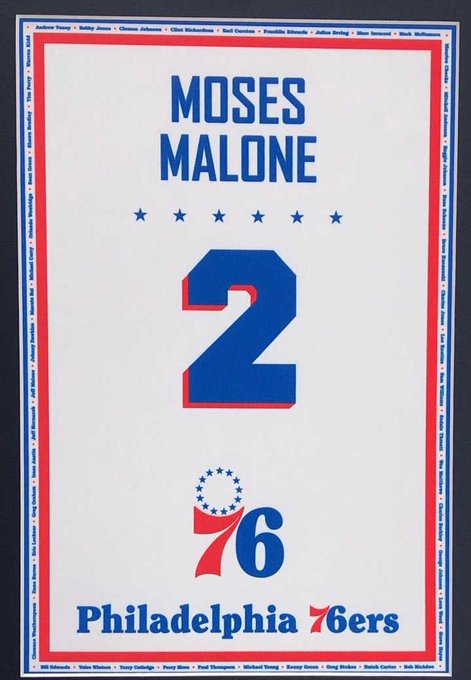
Moses Malone but the banner is different from most, if not all, retired jersey banners: per Malone's request, the banner includes the names of all 48 of his Philadelphia teammates--not just the members of the 1983 NBA championship team, but every single person who played for the team during his five seasons with the organization (1983-86, plus a curtain call in 1994). The 76ers also
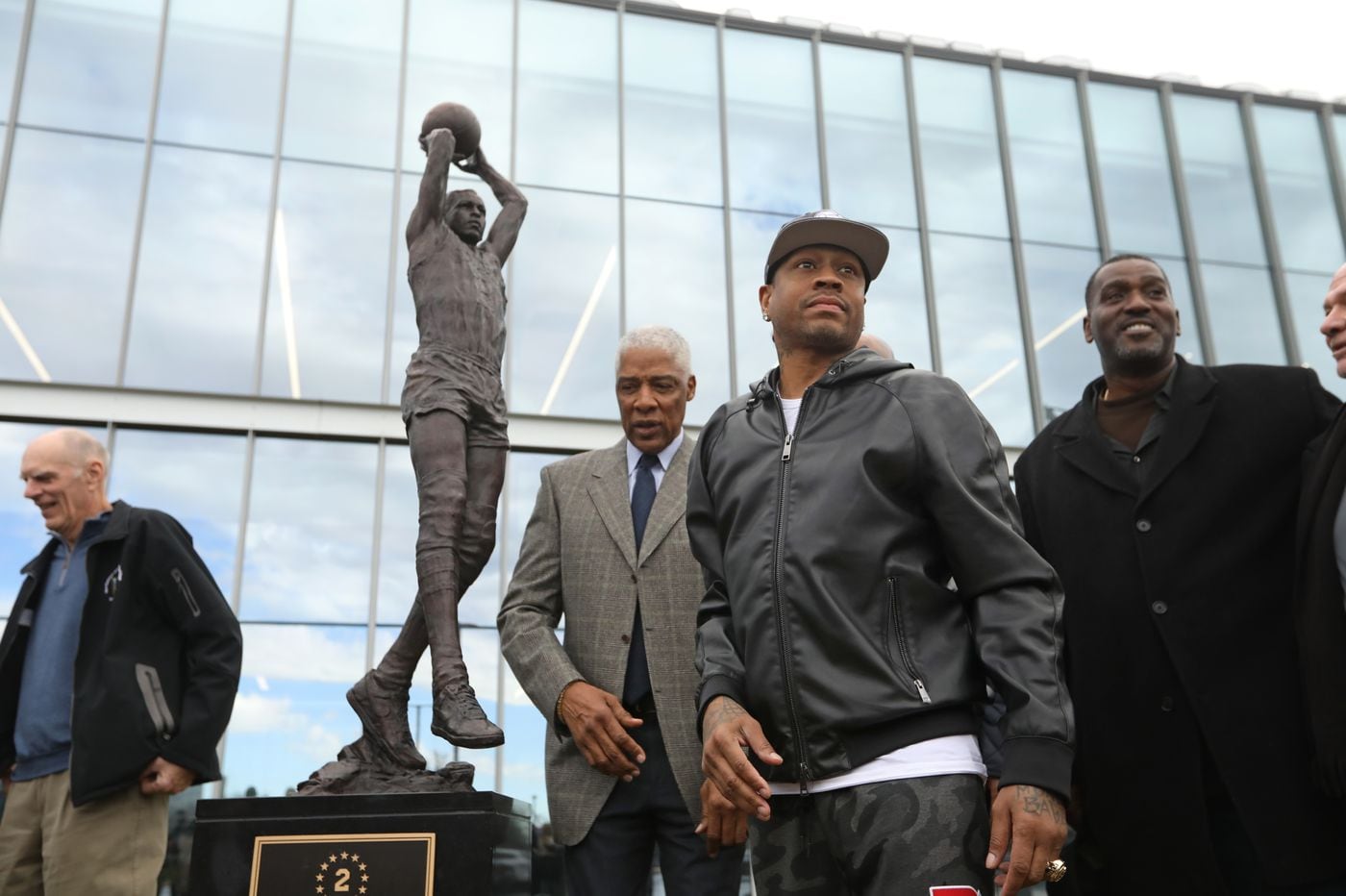
honored Malone with a statute placed on their Legends Walk near their Camden, New Jersey practice facility. Other 76ers who have been honored with Legends Walk statues are Wilt Chamberlain, Billy Cunningham, Hal Greer, Julius Erving and Maurice Cheeks
Here is a picture of the banner, and a picture of the statue, with (left to right) Bobby Jones, Julius Erving and Allen Iverson among those present to pay tribute to Malone.
Malone passed away in 2015 but he would be happy that the team remembered and honored his one condition about his jersey being retired. Malone's request speaks volumes about the kind of person and teammate he was.
Michael Lee wrote a nice story about Malone's career and the ceremony and some of the quotes in that piece provide meaningful context about one of the most underrated great players of all-time. His Philadelphia Coach,
Hall of Famer Billy Cunningham, said, "Moses Malone is as smart a basketball player that I've ever been around."
Pat Williams, the general manager who brought both Julius Erving and Moses Malone to Philadelphia, described Malone's style of play: "He wasn't beautiful. He wasn't graceful. He just outworked people. Out-hustled them. Went after every rebound. Never backed down. And we haven't seen that type of player ever again, probably never will." Maurice Cheeks recalled Malone's sense of humor; after a game during which Cheeks only made one shot, Malone quipped that he should have at least made two so that people would not assume that the one was just a lucky shot.
Unlike many of today's superstars who incessantly seek out the spotlight and demand that they are recognized as "The Man," Malone--the reigning (1982) MVP joining a Philadelphia team led by the previous (1981) MVP Julius Erving--quashed any hint of that nonsense with a simple, direct statement: "This Doc's team." Malone deservedly won the 1983 regular season MVP and the 1983 Finals MVP as the 76ers rolled to 65-17 regular season mark and then went on a record-setting 12-1 playoff run, but Malone let his play speak for itself as opposed to running his mouth. Malone and Erving each earned All-NBA First Team honors, and Erving finished fifth in MVP voting. They provided the blueprint for the way that two all-time great players should share the spotlight and the glory while leading their team to the top; it is a shame that they did not get paired together a few years earlier (Erving turned 33 during the season that Malone joined the team) or they might have won several championships in a row. Instead, they enjoyed one dominant season together, plus a strong push to the 1985 Eastern Conference Finals that ended with a defeat at the hands of the younger Boston Celtics, who were in the midst of a run of four straight NBA Finals appearances.
For a variety of reasons that fall outside the scope of this article, it is difficult to determine which basketball team is the greatest team ever but Philadelphia's
1983 championship team takes a back seat to no single season squad in pro basketball history; that does not mean that they are definitely the best, but it means you cannot point to a single team that is clearly better.
Malone was the dominant force on that dominant team, along with the incomparable Erving, and it is fitting that the 76ers honored not only Malone's greatness but that they did so in keeping with his wish to recognize all of his teammates as well.
Labels: Andrew Toney, Bobby Jones, Clemon Johnson, Clint Richardson, Earl Cureton, Franklin Edwards, Julius Erving, Marc Iavaroni, Mark McNamara, Maurice Cheeks, Moses Malone, Philadelphia 76ers, Reggie Johnson
posted by David Friedman @ 1:25 PM
Thoughts and Observations About the 2018 Naismith Memorial Basketball Hall of Fame Enshrinement Ceremony
In my article Maurice Cheeks, Charlie Scott and Rod Thorn Are Among the Basketball Hall of Fame's Newest Members, I focused on three of the 13 members of the Basketball Hall of Fame's 2018 class. Last night, those men and their classmates were officially enshrined.
Grant Hill was enshrined first. He and 2018 Hall of Fame classmate Jason Kidd will forever be linked not only as co-Rookies of the Year in 1995 but also as unselfish, all-around players who focused first and foremost on team success. Hill alluded to his tendency to be verbose and joked that his wife had urged him to remember the "Five Bs: Be brief, brother, be brief." Turning serious, Hill said that he "fell in love with the game of basketball" by watching Patrick Ewing dominate in both college and the NBA. Hill called Ewing his "basketball hero." Ewing and Duke Coach Mike Krzyzewski were Hill's two presenters. Hill thanked Coach Krzyzewski for providing the "blueprint" for success. Next, Hill mentioned Isiah Thomas. Hill seemed uncertain whether or not Thomas was in attendance (perhaps that is why he did not choose Thomas as a presenter as well) but as soon as Hill realized that Thomas was in the building he called him up to the stage and embraced Thomas, who he called a "hero, a friend and an advocate for me." Hill thanked Alonzo Mourning for providing the inspiration for how to come back from health problems/injuries. Hill became emotional when he thanked his parents for how they raised him and when he acknowledged his two daughters and his wife. Hill asked his wife if his speech had been short enough and he promised that the other enshrinees' speeches would be shorter.
Rod Thorn spoke next. He was presented by Jerry West. Thorn thanked the Hall of Fame and Jerry Colangelo in particular. Thorn singled out three Hall of Famers who had a special impact on him: Bob ("Slick") Leonard, Richie Guerin and Lenny Wilkens.
Younger fans may not remember or know that Thorn was a collegiate star at West Virginia who was selected by the Baltimore Bullets with the second overall pick in the 1963 NBA Draft. Thorn played eight seasons in the NBA before becoming a coach, general manager and league executive. After injuries forced him to retire from playing, Thorn considered going to law school before Kevin Loughery offered him a job as an assistant coach with the New York Nets in the ABA. Thorn recalled, "I knew in my heart I wasn't ready to let the game go."
Thorn said that since his career started as a player he wanted to mention three players "who all had a profound impact on my life": Julius Erving, Michael Jordan and Jason Kidd. Thorn said of Erving, "In 1974, my first season with the Nets, we won the league championship, sparked by the incomparable Julius Erving, who led the team in nearly every statistical category. Night after night, he would perform such incredible athletic feats that would have Kevin and I looking at each other and exclaiming, 'I cannot believe he just did that.' As great as Doc was as a player, he was equally good as a teammate. Thank you Doc for proving that superheroes can be humans, too."
These comments reinforce what Thorn told me over a decade ago about Erving: "I think that he was the best teammate of all the players I've been
involved with in 40-plus years of NBA basketball. He was our leading
scorer, our leading rebounder, our leading shot blocker, our leading
assist guy--you name it, he led our team in it, plus he was the leader of
our team. He guarded the best forward every night, whether it was a
small forward or a big forward. He took most of the big shots. Not only
was he a great player, but more importantly he was a great teammate. He had great lateral quickness and he was a tremendous jumper. He was a
tough guy--that is one thing that is not talked about that much when you
talk about Julius, because of his great athleticism, but he was a tough
guy. I mean he would physically get after guys and play hard. He took a
challenge. He played 43-44 minutes a game for us and guarded the best
guy on the other team every night and was our leading scorer, so the
energy that he expended during a game was much more than the average
player did. It was just phenomenal what he did."
As the Chicago Bulls' general manager, Thorn drafted Michael Jordan.
Thorn joked that without Jordan he would not have a Wikipedia page and
he would not have people sending him items to autograph asking for his
signature and "by the way" asking for Jordan's signature as well.
Thorn
won the 2002 NBA Executive of the Year Award after acquiring Kidd and
building the Nets into a championship contender. Thorn recalled that when he rejoined the Nets, "The team had challenges defending, rebounding and passing, which as you know are the ingredients of a 26 win season." After trading for Kidd, Thorn's Nets won 52 games, one of the best one season turnarounds in league history.
Maurice Cheeks followed Thorn. In the video tribute before Cheeks spoke, Erving said, "He had a very, very high basketball IQ. He was a champion, he was an All-Star and I loved playing with him." Erving and Billy Cunningham presented Cheeks. Cheeks is known as a quiet man of few words but he gave the most emotionally gripping speech of the evening. He opened by saying, "This is amazing and Grant, you're right, this will be short." Cheeks credited his experiences growing up on the South Side of Chicago for teaching him to look out for others as others had looked out for him. He said, "My life has been a string of small moments that led to amazing experiences." Cheeks mentioned his high school teammate William Dise, who was a highly recruited player who signed with West Texas State on condition that the school also sign Cheeks, a skinny and lightly recruited prospect. Cheeks said that his career would have gone much differently if not for Dise.
Cheeks thanked Coach Cunningham and said that he was the kind of coach that you never wanted to let down. Cheeks praised Erving for teaching him how to be a pro and Cheeks also thanked his veteran teammates Andrew Toney, Moses Malone, Bobby Jones, Caldwell Jones, and Henry Bibby. Cheeks said, "Over the years I have had many reasons to thank the Lord and two of them are my beautiful kids...I'm proud to be your dad and I love you both." Cheeks thanked his three brothers, one of whom was murdered in 1991. Cheeks started to get emotional at that point and mentioned that Charles Barkley told him not to cry but Cheeks broke down when he talked about "my very first coach, Mama Cheeks" and all that she did for him and their family--including calling out Maurice's name and his brothers' names so that they would come inside when it got dark. Mama Cheeks attended the ceremony and she looked very proud. As Cheeks wept, Erving walked over, gently grabbed his shoulders and said softly, "Come on Mo, you can do it," lending a helping hand much like Cheeks had lent a helping hand to National Anthem singer Natalie Gilbert years ago. I felt as a kid that the 76ers were a special team with special people and moments like this just confirm that. I am so blessed to have watched that team and then to have had the opportunity to interview Erving, Cunningham, Jones and Pat Williams. Cheeks concluded by thanking the Hall of Fame for "thinking enough of my contributions to the sport to select me for such an honor. I cannot think of a better way to celebrate my 40 years in the NBA and my 62nd birthday (on Saturday). Thank you and God bless."
Later in the program, Charlie Scott was presented by Jerry Colangelo, Dave Cowens, Julius Erving, Spencer Haywood and Roy Williams. During the video tribute to Scott, Erving noted, "He broke the color barrier very much like Jackie Robinson did (in baseball), except it was getting a basketball scholarship to the University of North Carolina and integrating the school. Charlie Scott was a monster on the basketball court. He could score inside, he could score outside."
Scott began by explaining how he selected his presenters. He said that they were each friends of his for over 40 years. Scott joked that his wife said if they have known him for 40 years and still speak to him then they all deserve to be on the stage with him. "This is an honor that I always dreamed of but could never imagine happening," Scott declared. He called Dean Smith "My mentor and the person who I admire the most in my life." Scott thanked his North Carolina teammates, including Larry Miller, for standing beside him during the sometimes difficult racial integration process. He individually thanked each of his presenters. Regarding Erving and Cowens, the never hesitant to shoot Scott quipped that he helped each of them become great rebounders.
Scott concluded by thanking his wife and children. He said that he once asked a friend to describe him honestly, good and bad. Scott asked his family to raise their hands if they disagreed with this characterization: "People sometimes might take your aloofness as arrogance. You can become very demanding in getting your way. You don't know when to let things go. You never give compliments. You think you're always right....The shocker was his next sentence: Let me tell you about your bad points!" Scott paused after each point and noted that no one in his family raised their hands. He laughed and said, "This was the individual you had to deal with. Your unconditional love and understanding have been my North Star."
In 2015, I wondered if Julius Erving had been a Hall of Fame presenter more than anyone else. At that time, Erving had been selected as a presenter nine times. Now, including last night, he has been a presenter 14 times (9/11/21 note: I just added Alex English to this list after confirming that Erving was English's presenter):
1995: Presented Cheryl Miller
1996: None
1997: Alex English
1998-2000: None
2001: Presented Moses Malone
2002-2003: None
2004: Presented Clyde Drexler
2005: None
2006: Presented Dominique Wilkins
2007-2010: None
2011: Presented Artis Gilmore
2012: Presented Katrina McClain, Ralph Sampson and the All-American Red Heads
2013-2014: None
2015: Presented John Calipari
2016: Presented Allen Iverson and Shaquille O'Neal
2017: None
2018: Presented Maurice Cheeks and Charlie Scott
That list of names spans multiple generations and includes teammates, opponents and players who grew up idolizing Erving. What a tribute to Erving's deep and continuing impact on the sport!
There is a lot of depth to Ray Allen beyond his basketball accomplishments. When you read his words or listen to him speak you understand that he is a remarkable person, not just a great basketball player. Allen spoke repeatedly of the dedication, discipline, perfectionism and sacrifice that it takes to become a great individual player and to become a two-time NBA champion. Those words resonate and are true but what resonated the most is when he talked about his children. Allen was the only enshrinee who talked to/about each of his children specifically and described why each child is so special to him. Allen emphatically declared, "All of you kids are my greatest legacy. I learned in life that our kids pay attention to everything we do, everything we say and everything we don't say and everything we don't do. So I have to be an example to these young people at all times and we got to make sure that we are an example to the kids in our lives at all times, because we do set the tone and the example in all of our communities."
Allen also said, "I don't believe in talent. I'm here because I worked hard my whole life. Without that work, no one in this room would know who I am except my family. So to all the kids around the world watching, paying attention and aspiring to be like us or even on this stage, put the work in and watch the magical ride you go on."
Labels: Basketball Hall of Fame, Charlie Scott, Grant Hill, Isiah Thomas, Julius Erving, Maurice Cheeks, Mike Krzyzewski, Patrick Ewing, Ray Allen, Rod Thorn
posted by David Friedman @ 10:15 PM
Maurice Cheeks, Charlie Scott and Rod Thorn Are Among the Basketball Hall of Fame's Newest Members
In September, the Naismith Memorial Basketball Hall of Fame will welcome 13 new members: Ray Allen, Maurice Cheeks, Lefty Driesell, Grant Hill, Jason Kidd, Steve Nash, Dino Radja, Charlie Scott, Katie Smith, Tina Thompson, Rod Thorn, Ora Mae Washington and Rick Welts. Many media reports state that this class is "headlined" by Allen, Hill, Kidd and Nash--but this article will focus on Cheeks, Scott and Thorn, three individuals who have been eligible for induction for many years but have been overlooked by the Hall until now.
Maurice Cheeks was the starting point guard for the 1983 Philadelphia 76ers, who set a record by going 12-1 in the playoffs en route to sweeping the defending champion L.A. Lakers in the NBA Finals. Cheeks also started for the 1980 and 1982 Philadelphia teams that lost to the powerful Lakers in the NBA Finals. He made the All-Star team four times and earned five All-Defensive Team selections (including four First Team honors).
Cheeks never led the league in a statistical category but he was a consistently excellent performer who ranked first in career regular season steals and fifth in career regular season assists when he retired; he now ranks fifth and 13th respectively in those categories, ahead of many players who were inducted in the Hall of Fame before him. Cheeks posted an outstanding .523 career regular season field goal percentage, a testament not only to his shooting ability but also to his judicious shot selection. Cheeks understood when to shoot and when to deliver the ball to fellow Hall of Fame teammates such as Julius Erving, Moses Malone and Charles Barkley.
Cheeks had a Hall of Fame moment as a person during his tenure as Portland's head coach. Prior to a 2003 playoff game, 13 year old Natalie Gilbert froze as she was singing the National Anthem.
Cheeks walked over, put his arm around her and helped her finish singing. "It was like a guardian angel had come and put his arm around my
shoulder and helped me get through one of the most difficult experiences
I've ever had," said Gilbert.
Kidd, arguably the greatest point guard of his era, summed it perfectly upon learning that Cheeks will be joining him in the 2018 Hall of Fame class: "Mo Cheeks is who we all wanted to be."
Charlie Scott was the University of North Carolina's first black scholarship athlete. Scott made the All-America Team twice and he twice led the Tar Heels to the Final Four. He won Olympic gold with Team USA in 1968. Scott was drafted by the NBA's Boston Celtics but he signed with the ABA's Virginia Squires, winning the 1971 Rookie of the Year award after averaging 27.1 ppg. Scott also finished third in MVP balloting behind Hall of Famers Mel Daniels and Zelmo Beaty. The next season, rookie Julius Erving joined the Squires and Scott led the ABA in scoring (34.6 ppg) before leaving the Squires to jump to the NBA just before the playoffs. Scott joined the Phoenix Suns and the Suns sent Paul Silas to the Celtics as compensation since the Celtics owned Scott's NBA rights.
Scott spent three seasons with the Suns before being traded to the Boston Celtics for Paul Westphal in 1975. Scott played a key role for Boston's 1976 NBA championship team. His Hall of Fame selection is well deserved based on his outstanding amateur career in college/the Olympics, plus his high performance level as a pro in the ABA and NBA.
Rod Thorn was selected to the Hall of Fame as a Contributor after a long and successful basketball career during which he filled many roles, including player, coach, executive and league administrator. Thorn was an All-America performer at West Virginia before being selected second overall by the Baltimore Bullets in the 1963 NBA draft. He had a solid NBA playing career before becoming an assistant coach on Kevin Loughery's staff with the ABA's New York Nets, who won the 1974 ABA title largely thanks to Erving's spectacular all-around play. Thorn later became the Chicago Bulls' General Manager. He drafted Michael Jordan in 1984. From 1986-2000, Thorn served as the NBA's Executive Vice President of Operations. Thorn rejoined the Nets in 2000 and was selected as the NBA's Executive of the Year in 2002 after building the team into a championship contender.
Labels: Basketball Hall of Fame, Charlie Scott, Dino Radja, Gran Hill, Jason Kidd, Katie Smith, Lefty Driesell, Maurice Cheeks, Ora Mae Washington, Ray Allen, Rick Welts, Rod Thorn, Steve Nash, Tina Thompson
posted by David Friedman @ 1:24 PM
Julius Erving's Playoff Career, Part IV: A Graceful Descent
Championship Defense Falls Short
The 1982-83 Philadelphia 76ers may be the greatest single season team in NBA history but age and injuries prevented that squad from becoming a dynasty. Julius Erving (34 years old) and Bobby Jones (32) were both well into their 30s by the time the 1984 playoffs began. In 1983-84, Andrew Toney made the All-Star team for the second straight season and he averaged a career-high 20.4
ppg, but his career lasted just four more injury-shortened seasons. In 1983, Maurice Cheeks earned the first of his four All-Star selections and he had another solid season in 1984 (12.7 ppg, 6.4 apg, 2.3 spg, .550 FG%) but his emergence was not enough to overcome the declines suffered by the team's other key players.
Moses Malone was still young chronologically (29) but he was a 10 year veteran who had entered pro basketball straight out of high school and--even though no one could have realized this at the time and even though he played until he was 39--his best years were already behind him: Malone shot at least .500 from the field and averaged at least 14 rpg in each season from 1979-83 but he never matched either of those marks for the rest of his career; in 1982-83, Malone made the All-Defensive First Team for the first (and
only) time in his career but in 1983-84 his 1.5 bpg average did not even lead his team in that
category. In 1983-84, Malone led the NBA in rebounding (13.4 rpg) for the fourth straight season while also ranking 11th in scoring (22.7 ppg) but after winning back to back MVPs he dropped to 10th in the balloting and he slipped to the All-NBA Second Team after earning First Team honors two years in a row.
Erving ranked 12th in the league in scoring (22.4 ppg) and he averaged 26.2 ppg in February 1984 when Malone missed several games due to injuries. Erving led the 76ers in blocked shots (1.8 bpg, eighth in the league) and he ranked second on the team in scoring, steals (1.8 spg, 10th in the league) and rebounding (6.9 rpg) while also ranking third in assists (4.0 apg). He posted better averages than he did in 1982-83 in every category except for blocked shots (his average remained the same but he took over team leadership from Malone, a remarkable feat for an aging small forward). Erving earned his last All-NBA First Team selection in 1983 and he made the Second Team for the final time in 1984. Of the 20 oldest players in the NBA during the 1983-84 season (ranging in age from 33 to 37), Erving ranked first in scoring, edging out the 37 year old Kareem Abdul-Jabbar (21.5 ppg). Erving and Abdul-Jabbar were the only two players on that list who averaged at least 20 ppg.
In a 1992 interview conducted by Academy of Achievement, Erving offered an interesting take on the impact that fans can have on the game and the role that psychology plays in the evolution of an elite athlete:
When the crowd appreciates you, it encourages you to be a little more daring, I think. That's probably what the home court advantage is all about. With the crowds on your side, it's easier to play up to your potential. Generally, you'll have more players on the home team playing up to their potential than on the road team. Talented people sometimes react adversely to being booed or jeered or going into a foreign arena. It takes them a little longer to get focused and to reach their full potential and to get into stride, get into sync. You'll find some teams that are good home teams that are lousy road teams because of that. The perception is that the home team will always have an advantage. When you find a team that's a great team on the road, they're generally listed as a championship caliber team, because they've been able to overcome this. This is simply one of the psychological aspects of the game, which a lot of people write about and very few people study. I don't think I began to study it until I was in my late 20s. The last eight or nine years of my career I spent more time in learning about it because that's where there was a greater learning curve available for me, versus trying to physically jump higher or shoot straighter or run faster. The psychic side opened doors for me, physically and mentally and allowed me to become a better player at an older age. In 1981, at age 31, I was voted the best player in basketball and the most valuable player in the league. That's considered old. You have a lot of guys who start out at 20 now and this was after playing for 10 years. I thought that was something that I needed to credit--understanding the psychic side of the sport versus physically going out and doing anything differently.
Clearly, Erving studied his craft--and himself--very carefully and he did everything he could to maximize his productivity as an older player but the 1983 championship proved to be the crowning point of the Erving era in Philadelphia because young dynasties were emerging in Boston and Los Angeles under the leadership of Larry Bird and Magic Johnson respectively. Bird's Celtics finished with the best record in the NBA (62-20), while Johnson's Lakers topped the Western Conference with the league's second best record (54-28). Those teams combined to win every NBA title from 1984-88, facing each other in three of those five championship series. The 76ers went 52-30 in 1983-84, the league's third best record but 10 games behind the Celtics in the Atlantic Division race.
Injuries decimated the 76ers during the 1983-84 season; they went 3-6 without Malone at one point, part of a 3-8 stretch extending from late January through mid-February that was their worst skid since a 3-10 run during February-March 1979. The 76ers even briefly dropped to a second place tie (with the Knicks) in the Atlantic Division, putting in jeopardy their streak of never falling below second place since Erving joined the team in 1976. Erving pinpointed another problem in addition to the injuries: during the 76ers' dominant 1983 playoff run four players--Malone, Erving, Toney and Cheeks--provided the bulk of the scoring while the other players had much less prominent roles but that is not sustainable during the 82 game grind of the regular season. Erving said, "Even if we had not suffered the injuries, mentally there were problems. We had developed bad habits that were directly because of our success last year."
In the first round of the playoffs, the 76ers faced the 45-37 New Jersey Nets. On paper and based on playoff experience, the 76ers superficially looked like clear favorites but the Nets went 3-3 versus the 76ers during the regular season and as soon as the teams took the court in the postseason it became apparent that the Nets were a nightmare matchup for the 76ers. Micheal Ray Richardson, a 6-5 multi-talented guard who led the NBA in assists and steals during the 1979-80 season, played some of the best basketball of his career during the 1984 playoffs; he only averaged 12.0 ppg and 4.5 apg in 48 regular season games while he battled drug addiction but during the postseason he seemed to be clean, healthy and at the top of his game (sadly, he suffered another drug relapse two years later and the NBA banned him for life). Second year power forward Buck Williams was too big and strong for Erving or Jones to guard. Center Darryl Dawkins, who never reached his full potential in Philadelphia, was eager to get some revenge against his old team.
The Nets raced to a 39-29 first quarter lead in game one at Philadelphia en route to a 116-101 win. Philadelphia cut the margin to 97-91 at the 6:56 mark of the fourth quarter but New Jersey responded with a 15-2 run. This was the 76ers' first loss in 10 playoff games and their worst playoff opening loss in 18 years, while the Nets posted the first playoff victory in the franchise's NBA history. Williams led both teams in minutes (46), points (25) and rebounds (16). Otis Birdsong scored 24 points and Richardson provided a glimpse of coming attractions with 18 points, a game-high nine assists and six rebounds. Toney had 24 points, five assists and four rebounds. Malone added 20 points and 11 rebounds but he shot just 6-14 from the field and he only scored four points in the second half. Erving contributed 18 points, a team-high eight assists and seven rebounds but he also shot poorly from the field (6-16). Cheeks, who finished with 15 points and four assists, said, "Everything they did, they did well. Everything they tried, they did exactly right."
The Nets countered the 76ers' aggressive, trapping defense by relentlessly driving to the hoop. New Jersey Coach Stan Albeck explained, "Nothing stops pressure defenses better than layups."
During the championship season, the 76ers often fell behind before rallying to win but Philadelphia Coach Billy Cunningham had emphasized throughout the 1984 campaign that the 76ers were relying too much on their confidence in their ability to overcome any deficit. He offered this blunt appraisal of the loss: "There
is not really a lot I can say. They outplayed us in every phase of the
game." Cunningham lamented his team's defensive breakdowns: "Micheal Ray Richardson was doing things to us that we don't let Magic Johnson do."
Philadelphia cruised through the 1983 playoffs with a 12-1 record but after New Jersey's 116-102 game two victory the 76ers were one loss away from being swept out of the 1984 playoffs. Richardson scored a game-high 32 points, passed for a game-high nine assists, grabbed seven rebounds and swiped four steals. He shot 12-23 from the field, including 3-7 from three point range--an outstanding percentage for a player who shot just 14-58 (.241) from behind the arc during the regular season. "We're going for a sweep," Richardson declared.
The Nets did not just beat the 76ers--they humiliated them, building a 79-55 third quarter lead. The 76ers trimmed the deficit to five points, 91-86, but Richardson nailed a three pointer and converted a three point play as the Nets pulled away again. Dawkins added 22 points, six rebounds and two blocked shots, while Williams contributed 13 points, nine rebounds and four blocked shots in a game-high 44 minutes. The Nets won the rebounding battle 42-32 and they shot .563 from the field while holding the 76ers to .451 field goal shooting. The game did not look like an upset as much as it looked like a younger, faster and hungrier team outclassing an older, slower and lethargic team. Malone led the 76ers with 25 points and 12 rebounds but he shot just 8-18 from the field (.444, well below the .536 field goal percentage he posted in the 1983 playoffs). Toney finished with 22 points on 9-16 field goal shooting but he committed seven turnovers. Cheeks and Clint Richardson scored 13 points each but Cheeks needed three stitches over his left eye after taking a hard fall in the third quarter and he did not return to action after suffering that injury. Erving added 12 points and eight rebounds but he shot just 5-13 from the field.
The 76ers avoided the sweep by winning game three, 108-100. Erving wore his championship ring to the arena, explaining to the media, "I don't usually do that. I wore it to show the team how much it takes to win it." Erving scored a game-high 27 points, including 11 in the fourth quarter and five during the 76ers' 9-0 run to finish the game. He shot 12-20 from the field and tied Cheeks for team-high honors with five assists. In an April 23, 1984 article for the
New York Times, Dave Anderson described Erving's heroics:
If the 76ers do survive this series, they will remember what Julius Erving did yesterday in their moments of truth down the stretch. With his team trailing, 100-99, and 91 seconds remaining, Doctor J put them ahead and kept them ahead. In those 91 seconds, he showed why he was the only current player among the 12 selected for the NBA's 25th anniversary team. In moments of truth, some players don't want the ball. He not only wants it, but even steals it.
Anderson's lyrical words are apt, though he got some of the facts wrong: Kareem Abdul-Jabbar was the other active player selected for the NBA's anniversary team in 1981 and the anniversary being celebrated was the 35th, not the 25th (that kind of inattention to detail could perhaps explain why Anderson later praised
Vincent Mallozzi's terrible Julius Erving biography).
Malone returned to form with 21 points on 8-15 field goal shooting, a game-high 17 rebounds and a game-high five blocked shots. Cheeks added 19 points, while Toney had 17 points and four assists. Williams led the Nets with 21 points and 17 rebounds in 47 minutes. Richardson finished with 16 points and 11 assists but Cheeks held him to five points and two assists in the second half. Dawkins had 16 points and six rebounds. Cunningham said, "Our object is to make it back to Philadelphia. We don't lose three in a row in Philly very often."
The 76ers achieved Cunningham's goal, winning game four 110-102. Erving and Malone each scored a game-high 22 points. Malone had 15 rebounds and three blocked shots, while Erving contributed a game-high eight assists plus five rebounds. Cheeks scored 20 points and Toney added 18 points despite shooting just 5-13 from the field. Albert King led the Nets with 20 points. Williams had 16 points and a game-high 18 rebounds. Richardson tied Erving for game-high honors with eight assists but he only scored 13 points on 6-19 field goal shooting. The 76ers built a 95-77 lead but the Nets, playing in front of a sellout crowd of 20,149 at Brendan Byrne Arena, cut the margin to 100-96 with 2:07 remaining. Bobby Jones scored a dunk and two free throws to hold the Nets at bay. Erving and Malone closed out the scoring by each sinking a pair of free throws. Erving said, "The inexperienced player's instincts are to go faster. The experienced player's instincts tell him to slow down, to gain control by maybe changing the pace. Those are the things the Nets are most lacking."
While Erving suggested that the 76ers were in the "driver's seat" now, the reality is that no NBA team had come back from a 2-0 deficit to win a five game series since Fort Wayne defeated St. Louis in the 1956 Western Division Finals. Perhaps that is why Cunningham sounded a more cautionary note than Erving: "We can't feel we've shown them anything. We won Sunday and Tuesday and can't relax now. We have to be even stronger." Cunningham also acknowledged that game four was a very tough contest: "It was as physical a game as I've seen in a long time. I'm glad it's not a seven game series. No one would survive."
After game four, Erving made an uncharacteristically brash statement, declaring that his team had not come all the way back just to "cough it up," that there was no way that the 76ers would lose and "you can mail in the stats." At first it seemed like Erving might not have to eat those words; the 76ers led game five 90-83 with 7:12 remaining but they collapsed down the stretch and lost 101-98. The 76ers had not lost three straight playoff games at home since 1969. The way that the young and physical Nets upset the defending champion was reminiscent of how the Spirits of St. Louis similarly stunned Erving's Nets in the 1975 ABA playoffs.
"Our season had more valleys than peaks and the playoff was indicative of the season--two peaks and three valleys," Erving said.
Some of the Nets' players said that veteran forwards Erving and Jones seemed tired in the waning moments, a charge that Erving declined to address. Erving scored just 12 points on 5-11 field goal shooting, though he contributed 10 rebounds, four assists and two blocked shots. After the game he said, "This is typical of the up and down season we had. I expected it to be a struggle. We forced them to play our kind of game and they responded to the challenge." He added, "The Nets made the big plays down the stretch and we didn't. They showed great character to win this series."
Richardson put on another great performance--a game-high 24 points plus six assists and six rebounds--but he also had plenty of help. Birdsong matched Richardson with 24 points and six assists, Williams had 17 points and a game-high 16 rebounds in 46 minutes and King chipped in 15 points, four rebounds and four assists. Toney led the 76ers with 22 points on 8-15 field goal shooting. Malone finished with 19 points and a team-high 14 rebounds but he again shot worse than .500 from the field (6-14). Cheeks had 16 points and a game-high seven assists but he shot just 6-15 from the field.
Richardson averaged 20.6 ppg, 8.6 apg and 5.2 rpg during the series while shooting .494 from the field in 42.4 mpg. Williams averaged 18.4 ppg and a series-high 15.2 rpg in 45.0 mpg; he shot .597 from the field and was a dominant force in the paint at both ends of the court. Malone led the 76ers in scoring (21.4 ppg) and rebounding (13.8 rpg) but he shot just .458 from the field. Toney averaged 20.6 ppg on .519 field goal shooting. Erving ranked third on the team in scoring (18.4 ppg), second in rebounding (6.4 rpg) and first in assists (5.0 apg). He also averaged 1.6 spg and 1.2 bpg. Erving shot .474 from the field and .864 from the free throw line. Cheeks, who battled various injuries throughout the series, scored 16.6 ppg on .522 field goal shooting but he only averaged 3.8 apg, tying Toney for second on the team.
One More Eastern Conference Finals Showdown Versus Boston
In Erving's final three seasons he gradually descended from elite level to "merely" All-Star status: from 1985-87 he was still one of the 15-20
best players in the league but he was no longer consistently dominant. In 1984-85, Erving set career-lows in scoring (20.0 ppg, second on the team), rebounding (5.3 rpg, third on the team) and assists (3.0 apg, third on the team). He remained potent defensively, averaging 1.7 spg (second on the team) and 1.4 bpg (second on the team). Erving was the fifth oldest player in the NBA, trailing only Kareem Abdul-Jabbar, former teammate Billy Paultz, George T. Johnson and Artis Gilmore. Of the 20 oldest players in the NBA (ranging in age from 32 to 38), Erving ranked third in scoring behind only Abdul-Jabbar (22.0 ppg) and 33 year old George Gervin (21.2 ppg).
Read more »Labels: Andrew Toney, Bobby Jones, Boston Celtics, Charles Barkley, Julius Erving, Kevin McHale, Larry Bird, Magic Johnson, Maurice Cheeks, Micheal Ray Richardson, Moses Malone, New Jersey Nets, Philadelphia 76ers
posted by David Friedman @ 2:25 PM
Julius Erving's Playoff Career, Part III: Consistency, Frustration and then a Glorious Championship Run
"I've always tried to tell myself that the work itself is the thing, that win, lose or draw, the work is really what counts. As hard as it was to make myself believe that sometimes, it was the only thing I had to cling to every year--that every game, every night, I did the best I could."--Julius Erving
Julius Erving and the New York Nets did not have much of a chance to celebrate after winning their second ABA championship in three years; during the summer of 1976, the ailing ABA reached an agreement with the NBA to form--as a
Sports Illustrated cover called it--"one big league" featuring "Dave" (Cowens) and "The Doctor." Four ABA teams--the Denver Nuggets, Indiana Pacers, New York Nets and San Antonio Spurs--joined the NBA at a cost of $3.2 million each; Kentucky owner John Y. Brown received a $3 million settlement for folding his franchise, while the Silna brothers--owners of the St. Louis franchise--
negotiated what was later called "the greatest sports deal of all-time": instead of getting a lump sum payment in 1976, they arranged for each of the surviving ABA teams to pay them a share of NBA television revenue in perpetuity.
In addition to the $3.2 million payment to the NBA, the Nets also had to compensate the New York Knicks $4.8 million over the next 10 years as indemnification for operating in the Knicks' territory. While Nets' owner Roy Boe scrambled to put together enough cash to keep his franchise afloat, Erving declared that the Nets had promised to redo his contract if the leagues merged; Erving's sublime talents and his box office value were a major reason for the merger, so Erving understandably wanted to be properly compensated but Boe denied that he had ever made that agreement with Erving and, in any case, Boe did not have the necessary funds to pay Erving more money. Erving missed training camp and the preseason as a result of the contract dispute. Boe tried to trade Erving to the Knicks in exchange for cash plus cancellation of the indemnification payment but the Knicks refused that offer. Philadelphia General Manager Pat Williams seized the opportunity to acquire the game's best player and right before the 1976-77 season began the New York Nets sold Julius Erving to the Philadelphia 76ers in a $6 million deal, a staggering sum for that era, with roughly half of that amount paid to the Nets and the other half to Erving over the course of a six year contract.
Pat Williams' 20-20-20 Vision
Erving joined a Philadelphia team that already had two All-Stars: forward George McGinnis (who shared 1974-75 ABA MVP honors with Erving before jumping to the NBA) and guard Doug Collins. Erving explained the situation to this writer: "The first day that I reported to Philadelphia, Pat Williams said, ‘We are going to be a really good team, but we really need to have three guys scoring 20 points. We don't need anybody scoring 30 points on our team.' He said, 'You, Doug Collins and McGinnis can be 20 point scorers for us and that will make us a better team.' That was a specific conversation. Hey, I had no problem scoring (only) 20 points. I’m trying to collect the 'Ws.' I had already been on title teams in the ABA and we thought that this would bring us to the championship."
The 76ers started out 0-2 before winning four straight games to take over first place in the Atlantic Division, a position that they maintained the rest of the way (save for a couple days when they slipped a half game behind Boston) en route to a 50-32 record and the franchise's first division title since 1968. The 76ers were maligned as a run and gun, one on one offensive team that did not play defense but they ranked first in the league in blocked shots, third in the league in defensive field goal percentage and fourth in the league in defensive rebounds. Erving made a strong contribution at that end of the court, ranking second on the team in defensive rebounds (6.1 drpg), steals (1.9 spg) and blocked shots (1.4 bpg).
Erving instantly turned the 76ers into the biggest gate attraction in the NBA. The 76ers improved to 1-2 with a 110-101 win over the New Orleans Jazz in front of an NBA-record crowd of more than 27,000 in the Louisiana Superdome. The next night, Erving scored 27 points (tying McGinnis for game-high honors) in a 116-94 win at Houston, playing before a crowd of 15,676--the best attendance ever for an NBA game in Texas. Only 5832 fans showed up for the Nets' NBA home debut without Erving but a few days later 18,116 fans packed the Spectrum to watch Erving's 76ers improve to 3-2 after pounding his former team 104-80.
Erving finished fifth in the MVP balloting; he led the 76ers in scoring (21.6 ppg, 15th in the NBA) and the team came close to achieving the 20-20-20 balance that Williams wanted: McGinnis averaged 21.4 ppg (16th in the NBA) and Collins averaged 18.3 ppg despite missing 24 games due to injuries. Erving averaged 8.5 rpg (second on the team), and 3.7 apg (fourth) in addition to his aforementioned defensive contributions; he was still an excellent all-around performer but his per game statistics declined across the board because he played fewer minutes than he had played in his first five seasons. Erving's rebounding average was 2.2 rpg lower than his lowest ABA rebounding average but it turned out to be the highest rebounding average of his NBA career. This is not unusual; as the following chart shows, most of the top 10 rebounders in pro basketball history (based on rpg average) posted their best rebounding average early in their careers:
Rank Player Career RPG average/Best RPG average (season)
1) Wilt Chamberlain 22.89/27.2 (second season)
2) Bill Russell 22.45/24.7 (eighth season)
3) Bob Pettit 16.22/20.3 (seventh season)
4) Jerry Lucas 15.61/21.1 (third season)
5) Nate Thurmond 15.00/22.0 (fifth season)
6) Mel Daniels 14.91/18.0 (fourth season)
7) Wes Unseld 13.99/18.2 (first season)
8) Walt Bellamy 13.65/19.0 (first season)
9) Dave Cowens 13.63/16.2 (third season)
10) Elgin Baylor 13.55/19.8 (third season)
Selected Others:
50) Larry Bird 10.00/11.0 (fourth season)
111) Julius Erving 8.47/15.7 (first season)
176) Magic Johnson 7.24/9.6 (third season)
222) Michael Jordan 6.22/8.0 (fifth season)
Rebounding is a skill set that does not tend to improve with age/experience, at least at the professional level. It is important to note that even Erving's reduced NBA rebounding averages still annually ranked among the best at the small forward position.
The 1976-77 season shattered any old guard NBA pretense about the ABA being inferior; ex-ABA players accounted for four of the NBA's top 10 scorers, two of the top four rebounders and 10 of the 24 All-Stars. Erving won the All-Star Game MVP, one of the few individual honors that he did not capture during his ABA career. Indiana Pacer Don Buse led the league in assists and steals. Five of the starters in the NBA Finals began their careers in the ABA: Julius Erving, George McGinnis, Caldwell Jones, Maurice Lucas and Dave Twardzik. David Thompson made the All-NBA First Team, while Erving, McGinnis and George Gervin made the All-NBA Second Team. The Nuggets and Spurs kept their rosters intact and immediately became perennial playoff
teams; the Nets understandably had to rebuild after Erving's departure, while the Pacers similarly had to rebuild after the core players from their three
championship teams aged, retired or finished their careers on other
teams.
The 76ers earned a first round bye and then faced their old rival the Boston Celtics in the Eastern Conference semifinals. The Celtics were the defending NBA champions but the 76ers enjoyed home court advantage because the Celtics only went 44-38 in the regular season. Erving scored a game-high 36 points in the series opener, including a dunk with eight seconds left in regulation to tie the score at 111--but after being fouled on that play he missed both free throws in a two to make one penalty situation. Jo Jo White missed a jumper and the game seemed to be headed to overtime after Erving blocked Sidney Wicks' shot but the ball bounced to White, who hit the game-winning jumper from the left baseline as time expired. White scored 21 points in the Celtics' 113-111 victory. "I feel empty," Erving said after the game. "We came here to win and we don't have anything. We are 0-1." However, Erving also noted that even if he had completed the potential three point play, "We would have lost by one instead of two." Erving's former Virginia teammate Charlie Scott led Boston with 22 points.
In a battle pitting a veteran future Hall of Fame forward against a Hall of Fame forward in his prime, 37 year old John Havlicek poured in a game-high 31 points on 11-25 field goal shooting but the 27 year old Erving had 30 points on 14-24 field goal shooting as the 76ers evened the series with a 113-101 victory. Havlicek also had nine rebounds and six assists, while Erving countered with six rebounds and four assists.
Erving scored a game-high 27 points as Philadelphia reclaimed home court advantage with a 109-100 game three win in Boston. Collins added 25 points and Lloyd Free--he had not yet legally changed his first name to World--scored 22 points on 9-13 field goal shooting in just 18 minutes. The Celtics had not lost at home in the playoffs since 1975, a 13 game streak. Havlicek led the Celtics with 25 points.
Dave Cowens had 37 points and 21 rebounds for the Celtics--including 23 first half points on 10-10 field goal shooting--in Boston's 124-119 game four win. Collins led the Sixers with 36 points, McGinnis added 27 and Erving had 23. White contributed 26 points, nine assists and seven rebounds. Havlicek only scored 12 points but he dished off for 15 assists.
The 76ers achieved Pat Williams' 20-20-20 balance in game five at home--but the third member of the 20 point trio was Steve Mix, not McGinnis: Collins (23 points), Erving (22) and Mix (20) led the way as Philadelphia took control of the series with a 110-91 win. Scott topped Boston with 20 points.
The proud Celtics forced a seventh game as both White and Havlicek played all 48 minutes to carry Boston to a 113-108 game six win. White scored a playoff career-high 40 points and Havlicek added 25 points. Collins led the Sixers with 32 points, McGinnis scored 22 points and Erving had an off game with just 14 points on 7-20 field goal shooting.
The first six games of the series were high scoring and free wheeling but game seven was a grind it out slugfest. Free missed his first six field goal attempts before scoring a game-high 27 points on 10-27 field goal shooting as his 76ers outlasted the Celtics 83-77. McGinnis scored 22 points before fouling out. Erving contributed 14
points on 6-19 field goal shooting and he also had eight rebounds. Erving said, "Our bench and depth was the key to the win. We had more
depth than they did. I never thought the starters would neutralize each
other as much as they did." Collins was the only other 76er who scored in double figures (10 points on 3-11 field goal shooting). White led the Celtics with 17 points on 7-24 field goal shooting but he did not score in the second half. Cowens pulled down a game-high 27 rebounds and blocked three shots but he only scored 11 points on 5-16 field goal shooting. This was just Boston's second loss in 13 seventh games.
Erving and Collins each scored 166 points (23.7 ppg) versus Boston. In his first NBA playoff series, Erving averaged 6.1 rpg, 2.7 apg, 1.9 spg and 1.3 bpg while shooting .464 from the field and .800 from the free throw line. This was the first time in 10 career playoff series that Erving averaged less than 26.0 ppg but he decisively won his matchup with Havlicek, outscoring his rival in five of the seven games (Havlicek averaged 19.9 ppg). McGinnis averaged 15.6 ppg and shot just .380 from the field.
Philadelphia faced the 49-33 Central Division champion Houston Rockets in the Eastern Conference Finals. The 76ers led 100-81 with 28 seconds remaining in the third quarter of game one but the Rockets cut the margin to 120-113 late in the fourth quarter before Erving hit a jumper and two free throws to seal Philadelphia's 128-117 win. Erving led the 76ers with 24 points, Collins added 23 points and McGinnis finished with 21 points, 13 rebounds and six assists. Erving said, "I thought we were capable of getting good shots any time we wanted. If we rebound and go to the boards like we did, we can run.
If we do, we'll continue to win."
Moses Malone poured in a game-high 32 points but he only scored 10 points in the second half as McGinnis--not known as a staunch defender--used his brawn to knock young Malone off of his favorite spot in the post. Houston Coach Tom Nissalke declared that Erving and McGinnis comprised "the best two players on one team in the league."
In game two, the 76ers' three star attack flourished again; this time McGinnis led the way with 21 points while Collins scored 20 points and Erving added 18 points as Philadelphia won 106-97. Malone only had seven points but Calvin Murphy (32 points) and Rudy Tomjanovich (22 points) picked up the slack.
When the series shifted to Houston, Malone returned to his dominating form with 30 points and 25 rebounds as the Rockets cruised to a 118-94 game three victory. This was the second of Malone's five 30-20 playoff games as a Rocket. Nissalke called Malone "the best rebounder in the game today" and Nissalke predicted, "In three years he will be one of the best players in the game"; Malone fulfilled that prophecy in 1978-79 when he won the first of his three MVPs. Nissalke changed his starting lineup for game three, replacing Goo Kennedy with the seven footer Kevin Kunnert. Kunnert responded with 12 points and 14 rebounds as the bigger Rockets won the rebounding battle 59-34 and slowed the 76ers' fast break to a crawl.
Erving led the 76ers with 28 points and he also had six assists but McGinnis only had 15 points on 6-18 field goal shooting and Collins scored nine points on 4-12 field goal shooting. "They killed us on the boards, they shot a lot better than we did, they had more control of the game than we did and they won the game," Erving said. "It might have been that we were lackadaisical or it might have been good defense. We were too liberal with the ball. We pushed it up fast, went for the jumper and missed it. The first two games we made it."
Free left the game in the second quarter with a bruised rib cage, an injury that would limit him for the rest of the postseason.
The 76ers' running game was back in high gear in game four and they raced to a 107-95 win to take a 3-1 series lead. Collins scored 36 points--including 10 straight points during the decisive fourth quarter run--and Erving added 29 points. Kunnert had another strong game (21 points, 17 rebounds) but an ineffective Malone only scored five points. Rudy Tomjanovich led the Rockets with 24 points.
The Rockets overcame Erving's 37 point explosion to avoid elimination, sending the series back to Houston after a 118-115 game five win. The 76ers squandered an 84-69 third quarter lead. John Lucas and Tomjanovich each scored 21 points.
Houston led for most of game six until Darryl Dawkins and Mike Dunleavy hit consecutive baskets to put Philadelphia on top 91-87 near the end of the third quarter. Dawkins, who jumped to the NBA straight out of high school in 1975, scored 13 of his 20 points in the third quarter. The 76ers pushed the lead to 104-97 with 5:27 remaining in the fourth quarter but then they went scoreless for three minutes, allowing the Rockets to make one final rally. Erving broke that drought with a basket and two free throws to make the score 108-105 and then Houston countered with hoops by John Lucas and Mike Newlin. Henry Bibby made what turned out to be the game-winning shot with :37 remaining. Lucas' driving layup with five seconds left was disallowed by Jake O'Donnell, who ruled that Lucas had charged into Collins. Erving scored a game-high 34 points, snared nine rebounds and dished off for six assists in the 112-109 win. Collins added 27 points. Free did not play due to his rib injury and a
partially collapsed lung. Lucas led the Rockets with 24 points.
"They didn't come out with any of that cheetah stuff," said Nissalke, referring to the 76ers' fast break attack. "They were coming down and setting up and shouting, 'Where's Doc?' It's unbelievable that a team that has lived and died by the fast break would run set plays like that, but he's the best forward who has ever played the game."
Erving averaged 28.3 ppg, 6.3 rpg, 6.0 apg, 2.0 spg and 1.2 bpg versus Houston in the Eastern Conference Finals while shooting .570 from the field and .800 from the free throw line. Erving's rebounding was below the standard he set during his ABA career but in all other statistical categories his performance mirrored his outstanding all-around production in his three previous "Final Four" (Division Finals/Conference Finals) appearances. Collins averaged 23.5 ppg and shot .604 from the field. McGinnis averaged 13.7 ppg and shot just .353 from the field. Malone averaged 17.2 rpg in the Eastern Conference Finals, the best rebounding performance in a series in franchise history at that time (Malone later surpassed that mark twice).
Philadelphia faced the Portland Trailblazers in the NBA Finals. Portland center Bill Walton finished second to the L.A. Lakers' Kareem Abdul-Jabbar in the MVP voting, earned a spot on the All-NBA Second Team and beat out Abdul-Jabbar for All-Defensive First Team honors. Walton led the NBA in rebounding (14.4 rpg) and blocked shots (3.2 bpg). Portland finished second in the Pacific Division with a 49-33 record but defeated the 53-29 Pacific Division champion Lakers 4-0 in the Western Conference Finals.
Philadelphia Coach Gene Shue closed the team's practices to the public and the media prior to game one. Asked if Shue did this out of secrecy, a 76er official quipped that Shue did it because of "embarrassment" (the 76ers were not known for their diligent practice habits, something that irritated the hard-working Erving)--but once game one of the NBA Finals began it became clear what the 76ers had been hiding: the 76ers nullified the aggressive trapping of Portland's guards by having center Caldwell Jones bring the ball up the court. After Philadelphia's 107-101 win, Shue explained, "The strength of the Portland team is in the pressure their guards apply, so we attacked them at their weakest link."
"It was a good tactic," Portland Coach Jack Ramsay admitted. "It worked very effectively. We tried several things against it, but none worked very well." Ramsay also said that to win the series Portland had to hold the Erving-McGinnis-Collins trio to around 60 total points.
"This is what I call net cutting time," Erving said. "The playoffs--I love them. This is the best time of year, what we work for all winter. Not everybody gets the chance to be here and as long as I'm here I'm going to do something. I'm going to make my presence felt."
Erving scored a game-high 33 points, shooting 14-24 from the field and making all five of his free throws. He also had five rebounds, four assists and three steals. Collins had a similar stat line: 30 points, 12-23 field goal shooting, 6-6 free throw shooting, six rebounds, six assists, two steals. McGinnis scored just eight points on 3-12 field goal shooting in 22 foul-plagued minutes and his game one struggles foreshadowed what would become one of the major stories of the series. Walton's performance also provided some foreshadowing: he produced 28 points, a game-high 20 rebounds, three assists and two blocked shots. Portland committed 34 turnovers, an astounding total for any game, let alone game one of the NBA Finals. Philadelphia also enjoyed the advantage from the free throw line, shooting 27-32 compared to Portland's 15-18.
Collins scored a game-high 27 points as the 76ers took a 2-0 lead with a 107-89 win. Erving added 20 points, four rebounds, four assists and five steals. Bibby scored all 15 of his points in the first half as the 76ers built a 61-43 lead and he finished with a game-high 11 assists. "People put us down all the time," Bibby said. "They say we're a bunch of one on one players, we can't play team ball, we don't execute our plays well, we can't do the job on defense. They keep saying it--but we keep winning."
Erving added, "A lot of people think that we're a bunch of renegades. They think that a good, well-drilled team can run us apart. We are trying to prove them wrong. Portland is very singular in its offensive strategy. There is one basic play they like to run 75 percent of the time--they set up Walton in the pivot and then try to free their cutters for layups. We know this, we've drilled against it and we've been able to stop it."
Walton led Portland with 17 points and a game-high 16 rebounds. Portland turned the ball over 29 times.
In the fourth quarter, Dawkins threw Portland small forward Bobby Gross to the court as they battled for a loose ball. Dawkins took a swing at Gross but missed him and instead connected with Collins, who needed stitches above his right eye after the game. As the officials tried to restore order--not just among the players but also among dozens of fans who came on to the court--Portland power forward/enforcer Maurice Lucas came up behind Dawkins and hit Dawkins in the head. Dawkins and Lucas squared off to fight but emerged unscathed after several wild punches failed to connect. Both players were ejected; NBA Commissioner Larry O'Brien fined Dawkins and Lucas $2500 each but did not suspend either player. That skirmish may have initially seemed like just an afterthought--tensions erupting in a blowout game as one team takes a seemingly commanding 2-0 series lead--but in retrospect the entire tide of the series turned. The Blazers pulled together and rallied, while the 76ers--an emotionally fragile group under the best of circumstances--fell apart the rest of the way, a development that would have seemed improbable after their two impressive victories. Dawkins ripped a urinal off of the wall in the locker room and later expressed disappointment that none of his teammates had warned him about Lucas' sneak attack.
Enjoying the comforts of home after suffering two brutal road losses, the Blazers ambushed the 76ers in the first quarter of game three, taking a 32-12 lead. The 76ers battled back to only trail by four in the fourth quarter but Walton's consecutive hoops ignited a 26-10 run to put the game away. Portland won 129-107, their 16th straight victory at Memorial Coliseum and their 44th in 49 games (regular season and playoffs). The Blazers slashed their turnover total to 16 and Walton dominated at both ends of the court: 20 points, 18 rebounds, nine assists, four blocked shots, two steals. Lucas scored a game-high 29 points and he swiped 12 rebounds. Erving paced the 76ers with 28 points and five assists while also grabbing 11 rebounds but he received little help from anyone other than Collins (21 points on 9-13 field goal shooting). McGinnis scored 14 points on 6-17 field goal shooting, though he did contribute a team-high 12 rebounds.
If the 76ers thought that a 22 point blowout loss would be the low point of the series then they were sadly mistaken. The Blazers made nine of their first 10 field goal attempts in game four, sprinted to a 19-4 lead and never let the 76ers get closer than 11 points the rest of the way, cruising to a 130-98 win. During garbage time, the Portland reserves pushed the margin to 41 (126-85). Speedy guard Lionel Hollins scored a game-high 25 points for the Blazers, while Lucas (24 points, 12 rebounds, four assists) and Walton (12 points, 13 rebounds, seven assists, four blocked shots) controlled the paint. Erving, who led Philadelphia with 24 points, did not like his team's mindset: "We got to challenge the other team. Be aggressive. Get some big axes and chop arms and
legs." No other 76er scored more than 15 points and McGinnis was almost invisible (five points, six rebounds, 2-8 field goal shooting).
Game five started out very much like game four; the Blazers took a 16-9 lead as the 76ers missed 11 of their first 14 field goal attempts. The Blazers led by 22 points in the fourth quarter but this time the 76ers rallied, cutting the margin to 101-96 after Joe Bryant's long jumper with 3:26 remaining. Lucas countered with a jumper and then Hollins' layup extended the lead to nine. The Blazers won 110-104 to move within one victory of the young franchise's first NBA title. Gross led Portland with 25 points, Lucas added 20 points and 13 rebounds and Walton dominated inside (14 points, 24 rebounds, two blocked shots). Erving poured in a game-high 37 points, grabbed nine rebounds and passed for a team-high seven assists but only three other 76ers scored in double figures--and none of them shot better than .400 from the field.
The 76ers led 22-18 in the first quarter of game six before the Blazers went on a 39-20 run. Portland led 67-55 at halftime. The 76ers stayed in contact throughout the second half and then pulled to within two points after McGinnis' jumper with :18 left in the fourth quarter. McGinnis then tied up Gross for a jump ball and won the tap. The 76ers missed three potentially tying shots in the waning seconds--by Erving, Free and McGinnis--as Portland held on for a 109-107 win. Walton posted one of the most awesome stat lines in Finals history--20 points, 23 rebounds, eight blocked shots, seven assists--and he was selected as the Finals MVP. Gross led Portland with 24 points, while Hollins chipped in 20 points. Lucas had a very solid game (15 points, 10 rebounds, five assists, four steals).
Erving authored the first and only 40 point game of his NBA playoff career (he scored at least 40 points in seven of his 48 ABA playoff games). In addition to his 40 points on 17-29 field goal shooting, Erving had a game-high eight assists plus six rebounds and two steals. McGinnis broke out of his long playoff slump with 28 points and 16 rebounds but Caldwell Jones was the only other 76er who scored in double figures (10 points on 5-8 field goal shooting).
Erving averaged 30.3 ppg, 6.8 rpg and 5.0 apg in the NBA Finals. He shot .543 from the field and .857 from the free throw line. His 2.7 spg is still a record for a six game NBA Finals. Collins scored prolifically (19.7 ppg) and efficiently (.505 field goal shooting), while McGinnis was neither prolific (13.0 ppg) nor efficient (.388 field goal shooting).
According to information collected by Harvey Pollack and published in the 76ers' 1978 media guide, Erving led the team in playoff dunks (34, with a single-game high of five) and three point plays (converting 15 of 20 opportunities). Erving scored at least 20 points in 16 of Philadelphia's 19 playoff games--including each of the final 10--and he also posted six of his 11 highest scoring NBA playoff games. The 1977 postseason turned out to be Erving's most prolific NBA playoff campaign in scoring (27.3 ppg, third in the league), field goal percentage (.523) and steals (2.2 spg, fourth in the league).
Shortly after the 1977 NBA Finals ended, the
New York Times' Sam Goldaper wrote, "The recently concluded National Basketball Association season will be best remembered for two significant events--the emergence of Bill Walton as one of the game's dominant centers and the proof that Julius Erving could play the game of basketball as well as anyone who had ever played before him."
Read more »Labels: Andrew Toney, Bobby Jones, Boston Celtics, Doug Collins, Julius Erving, Kareem Abdul-Jabbar, L.A. Lakers, Larry Bird, Magic Johnson, Maurice Cheeks, Moses Malone, Philadelphia 76ers
posted by David Friedman @ 5:43 AM