Reflecting on Dick Barnett's Legacy
Dick Barnett, who passed away in his sleep yesterday at the age of 88, leaves behind a rich legacy not only as a basketball champion and Hall of Famer but also as an educator. Barnett was one of several stars from historically black colleges who told their inspiring stories in the must-see movie "Black Magic."
When the Tennessee A&I team that won three straight collegiate
national championships (1957-59) was inducted in the Naismith Memorial
Basketball Hall of Fame, Barnett--the team's biggest star--narrated the video that put the team's accomplishments in historical context. By the time that Barnett was inducted in the Naismith Memorial Basketball Hall of Fame individually in 2024,
he was in a wheelchair and unable to speak; his Knicks teammate Bill
Bradley spoke on his behalf, and Bradley praised Barnett as a two-way
player who was a key member of the Knicks' championship teams in
1970 and 1973. Barnett's trademark shot was his "Fall back, baby" jumper during which he curled up his legs underneath his body while saying his catchphrase, which meant that his teammates could fall back on defense because he knew that his shot was good.
Barnett began his NBA career with two solid seasons with the Syracuse Nationals before jumping to the American Basketball League (ABL) to play for his college coach John McClendon with the Cleveland Pipers, who won the 1962 ABL title. The ABL was the first professional basketball league to use the three point shot (the ABA was founded in 1967-68). After one ABL season, Barnett returned to the NBA as an L.A. Laker, and he played three seasons for the Lakers before being traded to the New York Knicks for Bob Boozer.
In his first season with the Knicks, Barnett averaged a career-high 23.1 ppg to rank sixth in scoring average (he finished seventh in total points, which is the method the NBA used to determine statistical leaders prior to 1970). He bounced back from an Achilles injury to earn his first and only All-Star selection in 1968. In the famous "Willis Reed game"--game seven of the 1970 NBA Finals, when Reed limped onto the court and scored four points despite being hobbled a painful leg injury--Barnett scored 21 points while also guarding Pantheon member Jerry West, the L.A. Lakers' star guard. Barnett's performance was overshadowed by Reed's heroics and by Walt Frazier's magnificent 36 point/19 assist/seven rebound stat line. Barnett averaged at least 12.2 ppg in each of his first 12 NBA seasons before his production dropped in his last two years.
After his playing career ended, Barnett earned a doctorate in education and communications from Fordham, and he wrote more than 20 books. He was an energetic and charismatic speaker, and a great role model not just for athletes but for all people.
Labels: Bill Bradley, Dick Barnett, John McClendon, L.A. Lakers, New York Knicks, Syracuse Nationals, Walt Frazier, Willis Reed
posted by David Friedman @ 4:57 PM


76ers Belatedly Add Dolph Schayes to the Team's Legends Walk
Dolph Schayes was the first NBA player to score 15,000 career points, and he ranked first in career scoring from 1958-63, breaking Ed Macauley's record before being surpassed by Bob Pettit (Macauley only held the record briefly in 1957, edging out George Mikan before Schayes took over). When Schayes retired, he held the NBA's career record for games played while also ranking second in career scoring and third in career rebounding. In 1955, he led the Syracuse Nationals to the NBA title. That is the first championship in the storied history of the Philadelphia 76ers (the team moved from Syracuse to Philadelphia in 1962). During the 1955 NBA Finals, Schayes led both teams in scoring (19.9 ppg) and rebounding (11.9 rpg); if the Finals MVP award existed at that time, he would have won it. Schayes finished in the top five in regular season MVP voting three times, and he had three other top 10 finishes while earning 12 All-NBA Team selections, six each to the First Team and the Second Team.
Schayes was selected to the 10 player NBA 25th Anniversary All-Time
team (1971), the NBA's 50 Greatest Players List (1996), and the NBA's 75th Anniversary Team (2021). In 2021, I included him in my revision of the NBA's 50 Greatest Players List: "Dolph Schayes was a great shooter. If he played today, he would be
capable of draining three pointers while still being an elite rebounder
and passer; bring prime Dolph Schayes to 2021 and he would probably be
an MVP caliber player whose style and effectiveness would be similar to
the style and effectiveness of Nikola Jokic." I also placed Schayes on my NBA 75th Anniversary Team.
Schayes retired in 1964 and he passed away in 2015, so it is bizarre that the 76ers had not added him to their Legends Walk until today. The other members of the 76ers' Legends Walk are Charles Barkley, Wilt Chamberlain, Maurice Cheeks, Billy Cunningham, Julius Erving, Hal Greer, Bobby Jones and Moses Malone. All of those players earned that honor, but Schayes was the franchise's first great player, and he should have been the first one honored.
Here are some pictures from today's ceremony honoring Dolph Schayes (Schayes' son Danny, who played in the NBA from 1981-99, is the tallest person in the bottom two pictures):
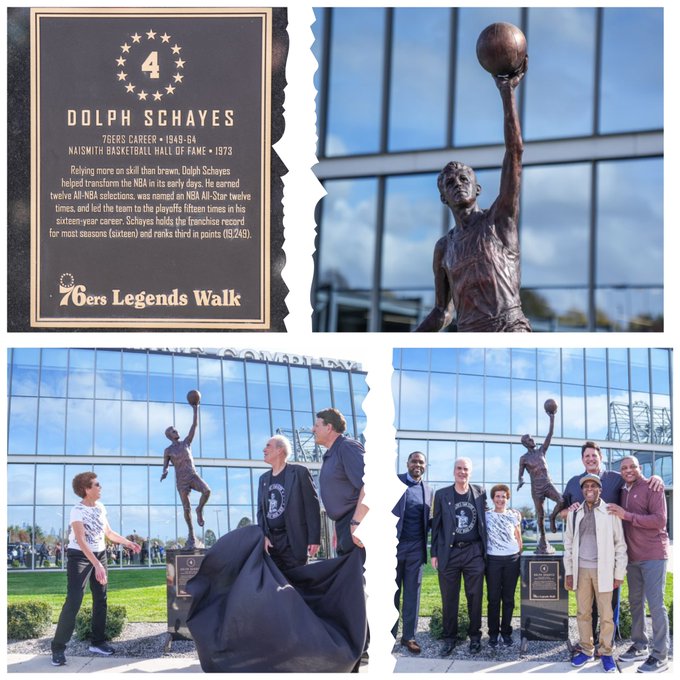
Labels: Dolph Schayes, Philadelphia 76ers, Syracuse Nationals
posted by David Friedman @ 7:24 PM
Dolph Schayes, Scorer/Rebounder/Passer Extraordinaire, Passes Away at 87
Dolph Schayes, one of the
greatest power forwards in pro basketball history, passed away today at the age of 87. Schayes held the NBA basketball career scoring record from 1958-63, succeeding George Mikan before being surpassed by Bob Pettit. Schayes was the first NBA player to score 15,000 career points and when he retired he ranked first in career games played (996), second in points scored (18,438) and third in rebounds (11,256). The NBA does not officially count the 809 points in 63 games (12.8 ppg) that Schayes scored in 1948-49 while winning the Rookie of the Year Award as a member of the Syracuse Nationals in the National Basketball League before the NBL and Basketball Association of America merged to form the NBA in 1949-50. The NBL did not record rebounding statistics, so those numbers are not available for Schayes' rookie campaign. Schayes is one of a select few players in the first quarter century of modern pro basketball (circa 1950-1974) who
led his team in scoring, rebounds and assists in the same season (22.5 ppg, 14.0 rpg and 3.2 apg in 1956-57, ranking in the top 10 in the league in each category).
It is difficult to compare Schayes to modern players because his era was so different from subsequent eras in terms of rules, facilities and many other factors but Schayes was without question one of the best players of his time and--based on his accomplishments--one of the greatest players of all-time. Schayes was selected to both the 10 player NBA 25th Anniversary All-Time
team (1971) and to the NBA's 50 Greatest Players List (1996). He is a
member of the Basketball Hall of Fame and the U.S. National Jewish
Sports Hall of Fame.
Schayes spent his entire 16 year career with the same franchise, the Syracuse Nationals, who became the Philadelphia 76ers in 1962-63. He led the Nationals to the 1955 NBA championship, the first title in franchise history. Schayes averaged 19.0 ppg and 12.8 rpg during that playoff run. Schayes served as player-coach in 1963-64 (his last season as a player) and he went on to win the Coach of the Year award in 1966.
I met Schayes at the National Sports Collectors Convention in Cleveland in 2004 and had the privilege of interviewing him. Schayes played against and coached Wilt Chamberlain, so it was interesting to get
his take on a hypothetical Wilt Chamberlain-Shaquille O'Neal matchup. Schayes struck me as a nice, down to earth and intelligent man. I wish I had been able to spend even more time with him but I am so happy that at least I had the opportunity to hear about his career and the careers of many other great players in his own words.
Labels: Dolph Schayes, Philadelphia 76ers, Syracuse Nationals, Wilt Chamberlain
posted by David Friedman @ 11:53 PM
Hal Greer: Productive, Consistent and Durable
This article originally appeared in the January 2006 issue of Hoop.
Star Guard on a Team for the Ages Hal Greer made the All-NBA Second Team seven straight years but never was selected to the All-NBA First Team. That’s what happens when you play during the same era as Oscar Robertson and Jerry West, but Greer--a 10-time All-Star who was honored as one of the NBA’s 50 Greatest Players--accomplished something that neither Robertson nor West did: being the leading playoff scorer on a team that defeated Bill Russell’s Boston Celtics in the playoffs and went on to win an NBA championship.
Russell’s Celtics won eight straight titles and 11 in 13 seasons, but many observers still maintain that the greatest single season team in NBA history is the 1966-67 Philadelphia 76ers. The Sixers beat Boston 4-1 in the Eastern Division finals and then defeated the Rick Barry-Nate Thurmond San Francisco Warriors in the NBA Finals. Greer produced 27.7 ppg, 5.9 rpg and 5.3 apg in the playoffs, while his teammate Wilt Chamberlain posted these mind-boggling numbers: 21.7 ppg, 29.1 rpg and 9.0 apg. Hall of Famer and Top 50 selection Billy Cunningham, the sixth man on the 1967 championship team, says, “Hal Greer was such a smart player. In his mind he had a book about every player he played against and what he had to do to make sure that he got free to get shots. He was probably as fine a screener as a guard as anybody. The thing about it was he knew that if he set a good screen then he would be open because he would force a switch and he would end up being matched up with a bigger, slower player that he knew he could easily beat to get whatever shot he wanted.”
Remember the old shoe commercial with playground legend
Lamar Mundane? The voiceover said that Mundane would shoot as soon as he crossed midcourt and the fans would yell, “Layup!” That would be a good way to describe Hal Greer’s top of the key jump shot; Sixers coach Alex Hannum said that Greer made that shot at a 70% clip and gave Greer the green light to launch from that range whenever he was open. Greer’s jump shot was so fluid and so deadly that he shot his free throws that way, connecting on better than 80% of his career attempts. Cunningham offers high praise for Greer’s jump shot: “It was as good as anybody’s who ever played the game. I think the beauty of Hal Greer’s game is that he knew where he was most effective and he never shot the ball from an area where he was not completely confident and comfortable. He never went outside of 18-20 feet maximum, but he was deadly and he had the ability to get to that spot.”
The Winding Road from West Virginia to Syracuse to Philadelphia Greer was born in Huntington, West Virginia on June 26, 1936 and when he signed with Marshall he became the first black athlete to play for a major college in that state. In 1955-56, his first varsity season, Greer shot a blistering 60.1% from the field, averaging 15.5 ppg and 6.7 ppg as Marshall won the Mid-American Conference title, earning a bid to the NCAA Tournament. Greer improved his numbers in the next two seasons (18.9 ppg and 13.8 rpg in 1956-57 and 23.6 ppg and 11.7 rpg in 1957-58) but Marshall finished second in the MAC to Miami (Oh.) both years, which meant no trips to the NCAA Tournament since at that time only the conference champion could earn an NCAA bid. The 6-2, 175 pound Greer played guard, forward and even center, battling on the boards with behemoths like 6-8, 240 pound Miami center (and future NBA All-Star) Wayne Embry.
The Syracuse Nationals selected Greer in the second round of the 1958 NBA draft. Initially, established stars Dolph Schayes, Red Kerr and George Yardley shouldered most of the offensive load. By 1961-62 Greer was clearly Syracuse’s top player. He averaged a team-high 22.8 ppg, finishing 13th in the league (1619 points; leaders were ranked by totals—not averages—until 1969-70) in one of the toughest individual scoring races ever; Chamberlain set the all-time single season record with 50.4 ppg (4029 points) and five other players averaged over 30 ppg. Greer’s .819 free throw shooting placed him ninth in the NBA.
Greer made the All-NBA Second team for the first time in 1962-63, placing ninth in scoring (1562 points; 19.5 ppg) and fifth in free throw shooting (.834). In 1963-64 the Nationals moved to Philadelphia and were renamed the 76ers. Schayes served as player-coach, but only played in 24 games. Greer ranked seventh in scoring (1865 points; 23.3 ppg), third in free throw shooting (.829) and seventh in assists (374; 4.7 apg). Despite his consistently excellent play, Greer’s team lost in the first round of the playoffs for the third straight season.
The Nationals replaced Philadelphia’s original NBA team, the Warriors, which had moved to San Francisco the year before, taking Chamberlain with them. Bringing Chamberlain back to Philadelphia via a midseason trade in 1964-65 transformed the 76ers into a title contender. Chamberlain and rookie power forward Luke Jackson provided the interior strength that the team had been missing. Greer again ranked among the league leaders in scoring, assists and free throw percentage.
The 76ers battled the Celtics in a memorable seven game Eastern Division finals. The Celtics were clinging to a 110-109 lead with just seconds left when Russell’s inbounds pass hit one of the wires holding up the backboard, a turnover that gave the 76ers one last chance. Greer tried to inbound the ball to smooth shooting forward Chet Walker, but John Havlicek’s steal preserved the Celtics’ win—a play immortalized by Celtics’ announcer Johnny Most’s raspy exclamation, “Havlicek stole the ball! It’s all over!”
Philadelphia had the NBA’s best record in 1965-66, 55-25. Greer ranked sixth in scoring (1819 points; 22.7 ppg), tenth in free throw percentage (.804) and tenth in assists (384; 4.8 apg). The much anticipated Eastern Division finals rematch with Boston proved to be a very anti-climactic 4-1 Celtics victory. Schayes won Coach of the Year honors, but the disappointing playoff run cost him his job. The 76ers hired Hannum, Chamberlain’s coach with the Warriors, with one goal in mind—beat the hated Celtics.
The 1966-67 Sixers finished with a 68-13 record, the best in NBA history at that time (a mark since broken by the Chamberlain-West 1971-72 Lakers and the Jordan-Pippen Bulls in 1995-96 and 1996-97). Greer averaged 22.1 ppg (ranking sixth in the NBA with 1765 points), 5.3 rpg and 3.8 apg. The 76ers rolled to the championship, winning 11 of 15 postseason games. Cunningham recalls, “We had a team whose only goal was to win a championship, especially considering how close the team came in 1965. It was a very focused team and a very unselfish team—and that’s the way Hal Greer played. Hal Greer never forced things or did things that would not be beneficial to the team.”
In 1967-68 the 76ers had the best record in the league for the third straight year, 62-20. Greer won the 1968 All-Star Game MVP after scoring 19 points in one quarter, a record that stood until Glen Rice had a 20 point quarter in the 1997 All-Star Game. Greer posted the highest regular season scoring average of his career (24.1 ppg), just trailing Chamberlain (24.3 ppg) for the team lead. Cunningham broke his wrist in the first round playoff series versus New York, but the 76ers beat the Knicks and took a 3-1 lead over the Celtics in the Eastern Division finals. The Celtics rallied to win three straight, eliminated the Sixers 100-96 in Philadelphia in game seven and went on to win the championship.
From the Sublime to the 1972-73 76ers Hannum resigned after the 1968 season and coached the Oakland Oaks to the 1968-69 ABA championship. General Manager Jack Ramsay took over as coach. Chamberlain and Sixers management feuded during the summer of 1968 until the team traded him to the Los Angeles Lakers. Jackson replaced Chamberlain at center but suffered the first of a series of injuries that derailed his career. In 1968-69, Cunningham took over the role of leading scorer, Greer averaged 23.1 ppg, making the All-NBA Second Team for final time, and the Sixers managed to post the second best record in the league, 55-27. Any thoughts of the 76ers being legitimate title contenders evaporated after Boston trounced Philadelphia 4-1 in the Eastern Division semifinals. Russell concluded his NBA career with a Finals victory over Chamberlain’s Lakers.
The 76ers slipped in the standings the next two years but still qualified for the playoffs. Greer made his last All-Star appearance in 1970 and by 1971-72 the Sixers slumped to 30-52. Then Cunningham jumped to the ABA before the 1972-73 season and Philadelphia collapsed, posting the worst record in NBA history, 9-73. That turned out to be Greer’s last season and, while it was hardly a fitting conclusion to his fine career, just the fact that he was still in the league was remarkable: at the time of Greer’s retirement he had played more games than anyone in NBA history (1122) and he ranked behind only Chamberlain, Robertson, West and Elgin Baylor on the regular season career scoring list. Greer’s 21,586 points are still the 76ers’ franchise record. Greer never made the All-NBA First Team, but he firmly established himself as one of the greatest guards in NBA history.
Labels: Billy Cunningham, Hal Greer, Jerry West, Oscar Robertson, Philadelphia 76ers, Syracuse Nationals, Wilt Chamberlain
posted by David Friedman @ 2:47 AM